


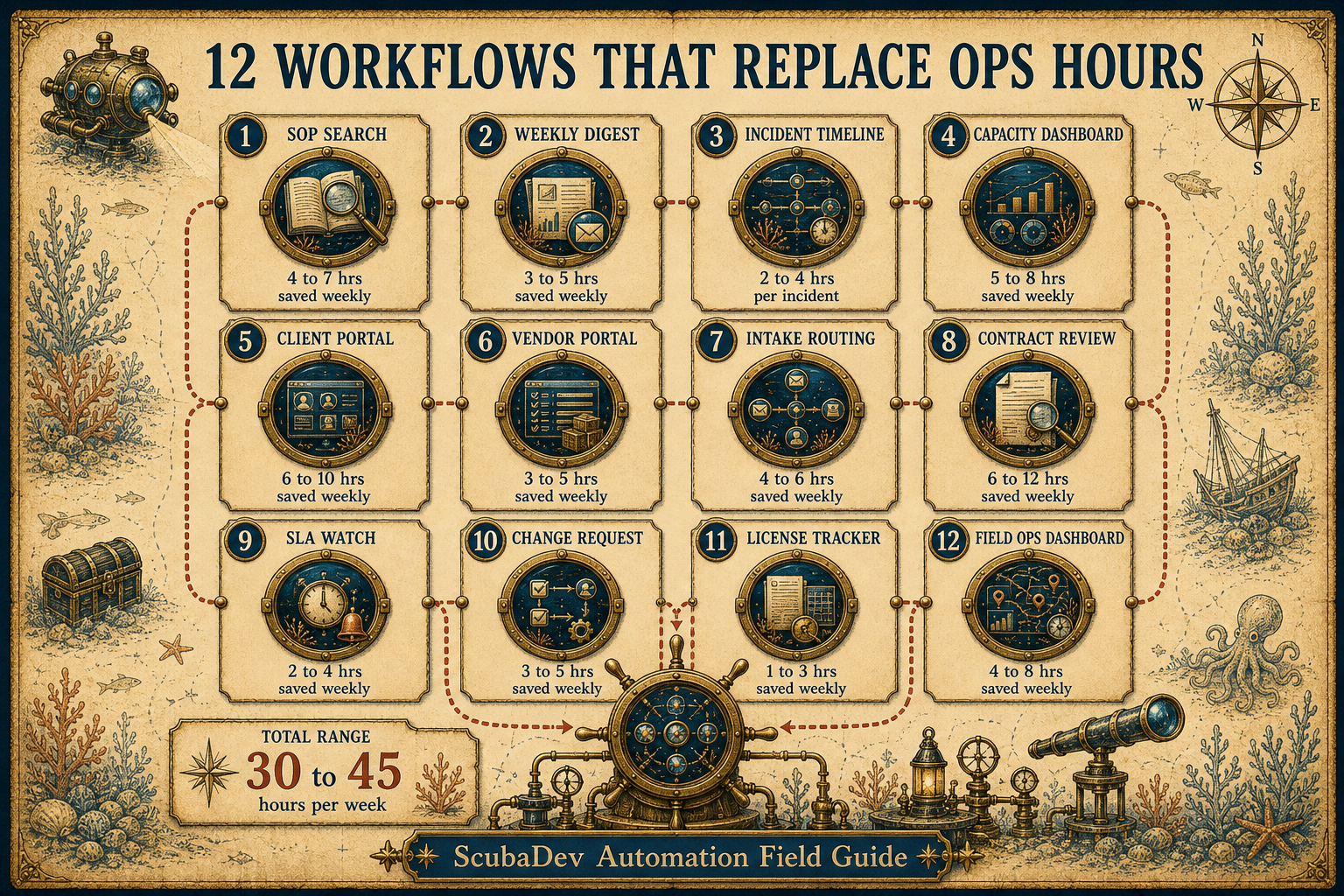
Twelve n8n workflows together deflect 30 to 45 hours per week of routine ops work for a mid-size company. Start with SOP search and weekly team digest because they ship fastest and create the knowledge surface every later automation needs.
Budget 3 to 8 weeks of engineering for the full set on a dedicated ops retainer. Self-host the stack on a small cloud box, keep humans on approvals, and use the AI Automation Playbook for the implementation patterns.
Below the surface
Each workflow is scored on effort, weekly hours saved, and stack fit. Depth means 1 to 2 weeks. Standard means 2 to 4 weeks. Deep end means 4 to 8 weeks because the work needs a portal, dashboard, document flow, or mobile surface.
The default stack is self-hosted n8n, Postgres, and one LLM. The important constraint is not whether the workflow can run. It is whether the team can observe it, approve risky steps, and change business rules without rebuilding the whole canvas.


By the numbers
The ops capacity math
Capacity deflected
30 to 45 hrs/wk
Draft TLDR range for the full twelve-workflow set.
Full-set build
3 to 8 wks
Engineering window when shipped as two-week slices.
Cloud box
$100/mo
Source stack assumption for a self-hosted n8n instance.
Starter set
3
SOP search, weekly digest, and change requests ship first.


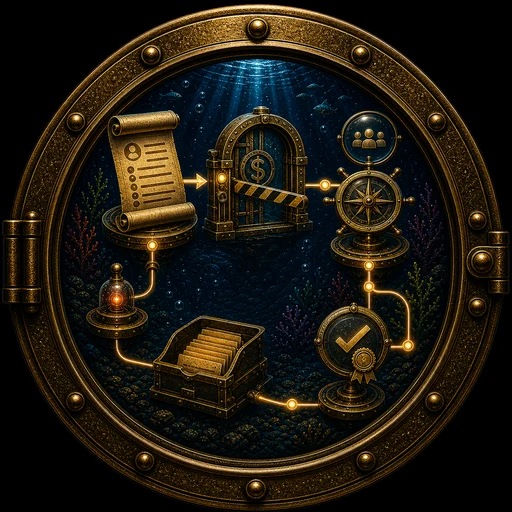


The twelve workflows we ship most
The list moves from quick compounding workflows to deeper portals, dashboards, and document processes. Each one keeps approval paths human-owned when judgment, money movement, or client-facing communication is involved.
- 01
SOP library with embed search
1 to 2 weeks, 4 to 7 hours saved weekly. The workflow turns a Drive folder into searchable answers inside Slack.
- 02
Weekly team digest
1 to 2 weeks, 3 to 5 hours saved weekly. Numbers from Stripe, HubSpot, GitHub, and tickets become a Monday narrative.
- 03
Incident timeline builder
2 weeks, 2 to 4 hours per incident. PagerDuty, Slack, Datadog, and GitHub events become a clean post-mortem timeline.
- 04
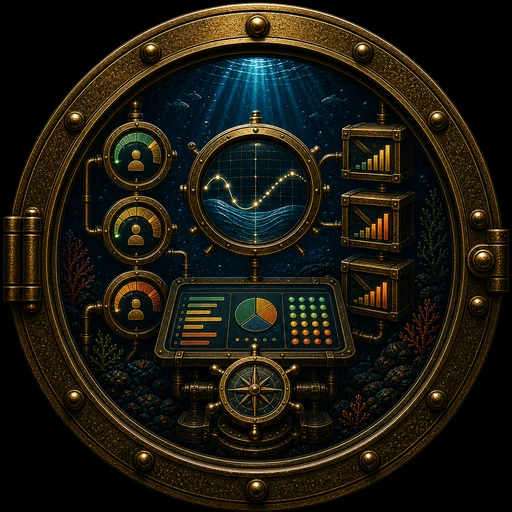
Capacity planning dashboard
3 to 4 weeks, 5 to 8 hours saved weekly. A Next.js dashboard answers whether the team can take on next month.
- 05
Client portal
4 to 6 weeks, 6 to 10 hours saved weekly. Status, files, and invoices move to one self-serve URL.
- 06
Vendor portal
3 to 5 weeks, 3 to 5 hours saved weekly. Vendors submit invoices, W-9s, PO status, and payment questions without email.
- 07
Routing intake form
1 to 2 weeks, 4 to 6 hours saved weekly. The classifier reads the request, assigns ownership, and drafts first response.
- 08
Contract review workflow
5 to 8 weeks, 6 to 12 hours saved weekly. Uploads, redlines, reviewer routing, negotiation logs, and signature state move together.
- 09
SLA breach dashboard
2 to 3 weeks, 2 to 4 hours saved weekly. Tickets approaching SLA get surfaced and escalated before the miss.
- 10
Change management request portal
3 to 4 weeks, 3 to 5 hours saved weekly. Requests become logged, priced, routed, and signed instead of buried in email.
- 11
Asset and license tracker
1 to 2 weeks, 1 to 3 hours saved weekly, with 8 to 12 during renewal season. Renewal drift and seat waste become visible.
- 12
Field ops dashboard
5 to 8 weeks, 4 to 8 hours saved weekly. Live crew location, job state, drive-time estimate, and dispatch controls share one surface.

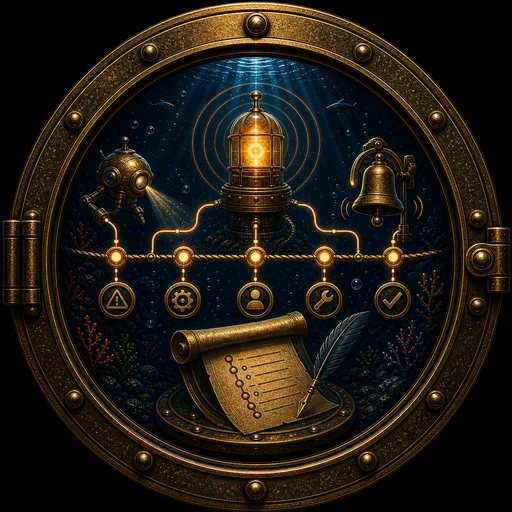
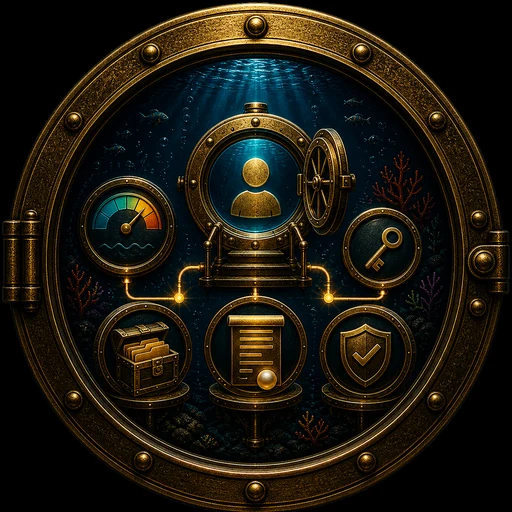

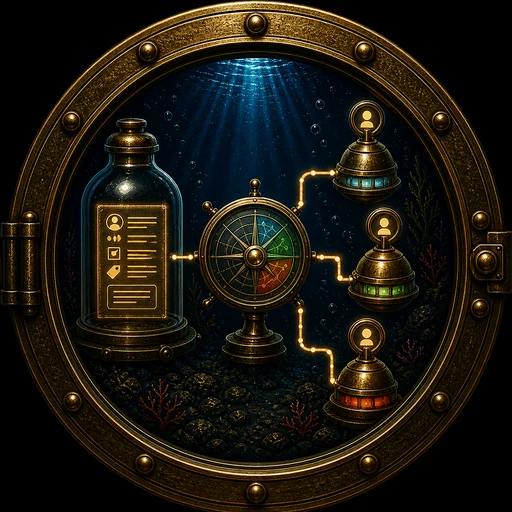


04 / First three
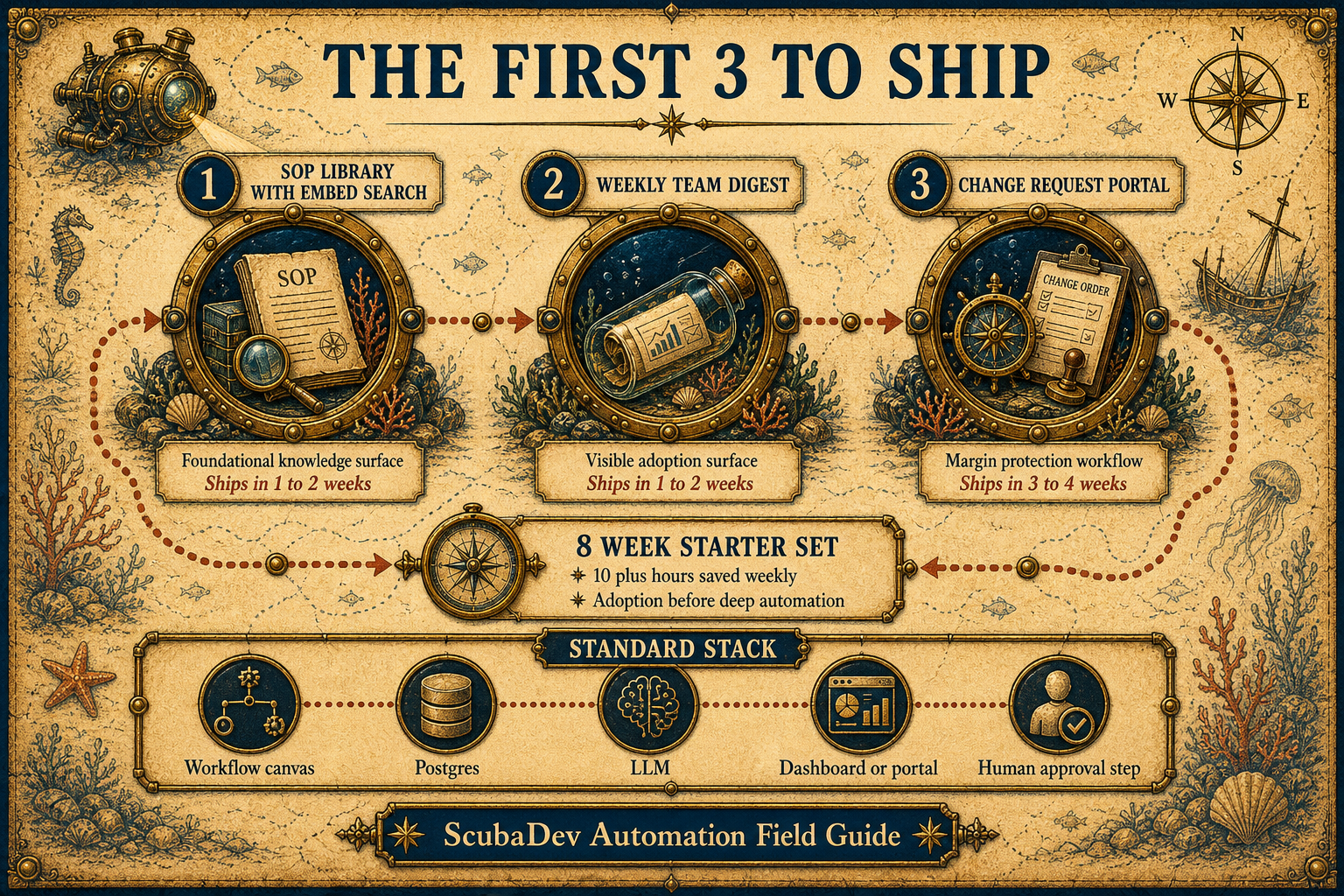
Ship adoption before deep automation
SOP search comes first because every later workflow can call it. Weekly digest comes second because everyone sees it. Change requests come third because scope control protects margin immediately.


What all twelve have in common
The workflows vary, but the production rules repeat.
- 01
Self-hosted by default
Host on a small box with managed Postgres when execution volume and data control matter.
- 02
Human in the loop
Client-facing messages, money movement, contract judgment, and policy exceptions stay approval-gated.
- 03
Observability from day one
Every execution, error, retry, and human override needs to be logged before the workflow is trusted.
- 04
Rules outside the canvas
SLA thresholds, pricing tiers, and approver lists live in data tables, not hard-coded workflow branches.
- 05
Built in two-week slices
Slice one is the happy path. Slice two is errors. Slice three is edge cases and reporting.
The stack we run
The source stack is intentionally boring: n8n for orchestration, Postgres for state, a small dashboard or portal where humans need a surface, and a model only where language or classification matters.
- 01
Compute
A single client-cluster box around $100 per month is the draft baseline.
- 02
Database
Managed Postgres or Supabase stores workflow state, rules, execution summaries, and approval records.
- 03
LLM
Claude Sonnet handles most classification and drafting. Use deeper reasoning only where the task demands it.
- 04
Observability
Better Stack plus n8n execution logs keep failures visible.
- 05
Frontend
Next.js carries client portals, dashboards, and dispatcher surfaces. n8n stays behind the interface.


FAQ
Can a non-developer build these?
No. The simpler workflows can be configured with help, but the portals, contract review, dashboards, and field ops surfaces are engineering work.
Does this work on Zapier or Make?
Partially. Digest, intake, and tracker workflows can run on both. Complex portals, contract review, and field ops are hard to ship cleanly on Zapier because of logic complexity and cost.
How do we measure hours saved?
Log the activity for four weeks before automation, then log again for four weeks after launch. The delta is the source of truth.
What goes wrong most?
Adoption. The first two workflows are intentionally visible because invisible automation dies quietly.
Can we AI-build these without engineers?
Use AI to accelerate implementation, but keep a senior engineer reviewing state, retries, data access, and approval logic before production.