




Most founders lose the deal in the scoping call, not the pitch. Ask too many questions and buyers think you are slow. Ask too few and you under-price the work by half. This guide turns the scoping call into seven clean beats that protect the relationship, the margin, and the delivery plan.
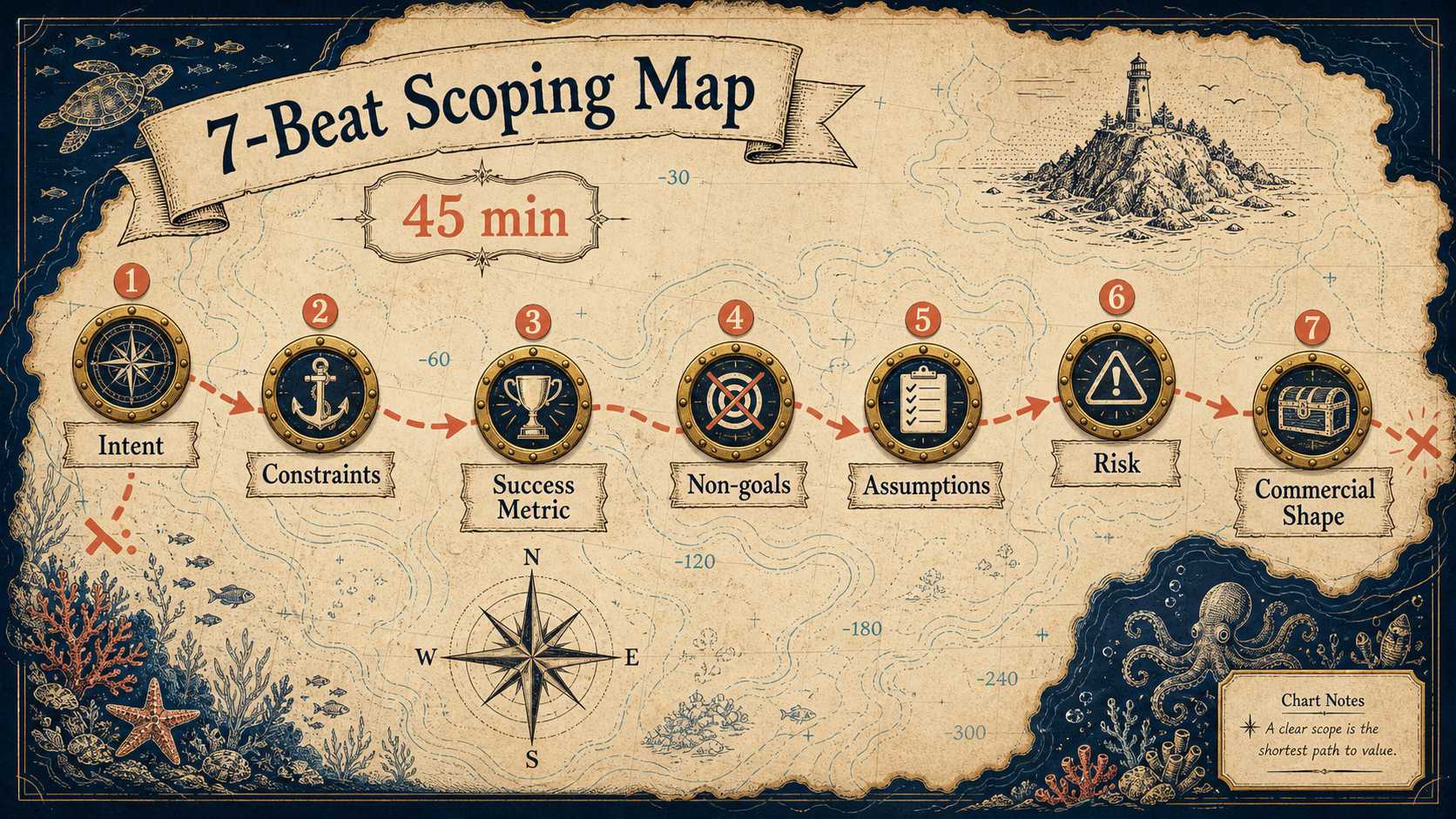
Run a 45-minute scoping call in seven beats: intent, constraints, success metric, non-goals, assumptions, risk, and commercial shape. Write the call up as a 1-page scope the same day and send it for sign-off before writing a line of code.
Do not fixed-price anything where assumptions make up more than 20 percent of the brief. Use a 2-week trial sprint when scope is fuzzy.
Below the surface
Why scoping is the highest-leverage hour in the whole project
Most founders lose the deal in the scoping call, not the pitch. A good scoping hour tells you what outcome matters, what constraints already exist, which risks could sink delivery, and which pricing model fits the actual ambiguity in the work.
One clean scoping hour is worth days of rework later. It is the fork between a project that ships with healthy margin and one that drifts into a rebuild nobody priced.


By the numbers
The constraints that decide the scope
Scope writeup
1 page
If the scope cannot fit on one page after the call, it is still a conversation.
Success metric
1
One number that will be different in 90 days turns a feature list into acceptance criteria.
Assumption line
20%
Above this, fixed price gets risky. Use time and materials with a cap or a trial sprint.
Discovery sprint
2 wks
When intent, data, or architecture is fuzzy, scope the real project after a bounded sprint.




The seven beats of a scoping call
Each beat earns a specific part of the SOW. Do not skip the uncomfortable ones. Non-goals, assumptions, and risk are where margin gets protected.
- 01

Intent
Ask what done looks like and what breaks if it does not ship.
If intent is fuzzy after 15 minutes, stop pricing and propose discovery. You cannot price a project whose purpose you cannot say in one sentence.
- 02
Constraints
Find what already exists and what cannot break.
Probe stack, compliance, downtime tolerance, reviewer availability, tests, legacy tools, vendor lock-in, and data access.
- 03

Success metric
Name one number that changes in 90 days.
The metric turns the brief into acceptance criteria. If you cannot measure it, you have a sketch, not a scoped feature.
- 04

Non-goals
Write down 3 to 6 things this project will not do.
Non-goals protect the project from every well-meaning "while we are at it" request in weeks 3, 5, and 7.
- 05

Assumptions
Name what you are pricing around but have not verified.
Assumptions are allowed. Unnamed assumptions are how fixed bids turn into unpaid discovery.
- 06

Risk
Ask what could make week 4 miss the timeline.
Write the top three risks with mitigations. No mitigation means the scope needs to carry the risk explicitly.
- 07

Commercial shape
Choose fixed fee, capped T&M, retainer, or trial sprint from the evidence.
The model should fall out of the prior six beats, not be negotiated from vibes at the end of the call.


03 / Assumption ratio
Use assumptions to decide what you can honestly price
Every scope has unknowns. The move is to name them, size them, and choose a commercial shape that does not pretend discovery is already done.
- 01
Under 20 percent
The brief is tight enough for fixed price if acceptance criteria are clear and the risks have mitigations.
- 02
20 to 50 percent
Use time and materials with a not-to-exceed ceiling, weekly burn visibility, and explicit assumption checks.
- 03
Above 50 percent
Sell a bounded discovery or trial sprint first, then scope the real project from evidence instead of hope.


04 / Pricing logic
Let the scope choose the commercial shape
The quote is not a personality test. The assumption ratio, acceptance criteria, and risk profile tell you which structure is honest.
Fixed fee
Tight scope, low assumption ratio, clear acceptance criteria. Add a 15 to 25 percent risk premium and protect change orders.
Capped T&M
Medium scope, 20 to 50 percent assumptions, and evolving requirements. Use a not-to-exceed ceiling and weekly burn visibility.
Monthly retainer
Ongoing product work where the client needs several outcomes before they know the full order. Scope the active request, not the whole future.
Trial sprint
Fuzzy scope, high assumptions, unclear data, or architectural unknowns. Sell two weeks of discovery before the real build.
05 / Scope artifact
The 1-page scope document
Write up the call the same day. Every scope we send fits on one page and has exactly these sections.
- 01
What we are building
Two to four sentences that describe the business outcome, not a vague feature pile.
- 02
Success metric
The one number that will be different when the project works.
- 03
Scope and non-goals
Deliverables with acceptance criteria, plus the explicit list of what is not included.
- 04
Assumptions and risks
Numbered assumptions, top three risks, and mitigations that both sides can inspect.
- 05
Commercial shape
Price or rate, timeline, payment terms, and the exit clause.
06 / Deal hygiene
What not to do on a scoping call
Do not pitch credentials first
The buyer knows why they joined. Lead with questions. Trust comes from how precisely you listen.
Do not say yes verbally
Verbal scope agreements do not survive the first change request. Every agreed scope lives in the SOW.
Do not quote live
Take 24 hours, write the scope, then send the price with the SOW. Buyers who cannot wait one day usually rewrite the scope four times.


FAQ
How long should a scoping call be?
A: 45 minutes. Under 30 and you usually skip one of the seven beats. Over 60 and the buyer starts rehashing instead of clarifying.
Should I send discovery questions before the call?
A: Yes. Send three or four questions 48 hours before the call: business problem, timeline, decision-maker, and existing stack.
What if the buyer insists on fixed price and the scope is fuzzy?
A: Offer a 2-week trial sprint at a fixed fee with fixed deliverables, then quote the full project from the sprint output.
How do I handle scope creep mid-project?
A: Every change request goes to a change-order form, gets priced, and either adds to the SOW or moves to a future phase.
What if my project is too small for a formal SOW?
A: The 1-page scope still applies. A $5K build may be seven bullets in a shared doc, but the discipline is the same.
Do I need a lawyer to write an SOW?
A: Use a field-tested template and have a lawyer review your master services agreement once. The SOW is mostly an operational artifact.