




n8n wins on price at scale, self-hosting, developer ergonomics, observability, and AI agent orchestration. Zapier wins on integration breadth, non-technical ownership, managed uptime, and compliance posture out of the box.
At ScubaDev, the default is n8n for workflows engineers own and Zapier for workflows client ops teams need to maintain without us. Neither platform is strictly better. The routing rule is about who owns the workflow after launch.
Below the surface
We ship workflows on both every week. Zapier belongs anywhere a non-technical owner needs to connect apps, maintain the automation, and stay inside a managed SaaS surface. n8n belongs anywhere the workflow has to scale, integrate deeply, run custom code, or orchestrate agents.
The useful comparison is not brand preference. It is ownership, complexity, volume, and AI depth. Use this map before you price a workflow, hand it to ops, or make it part of a production product.
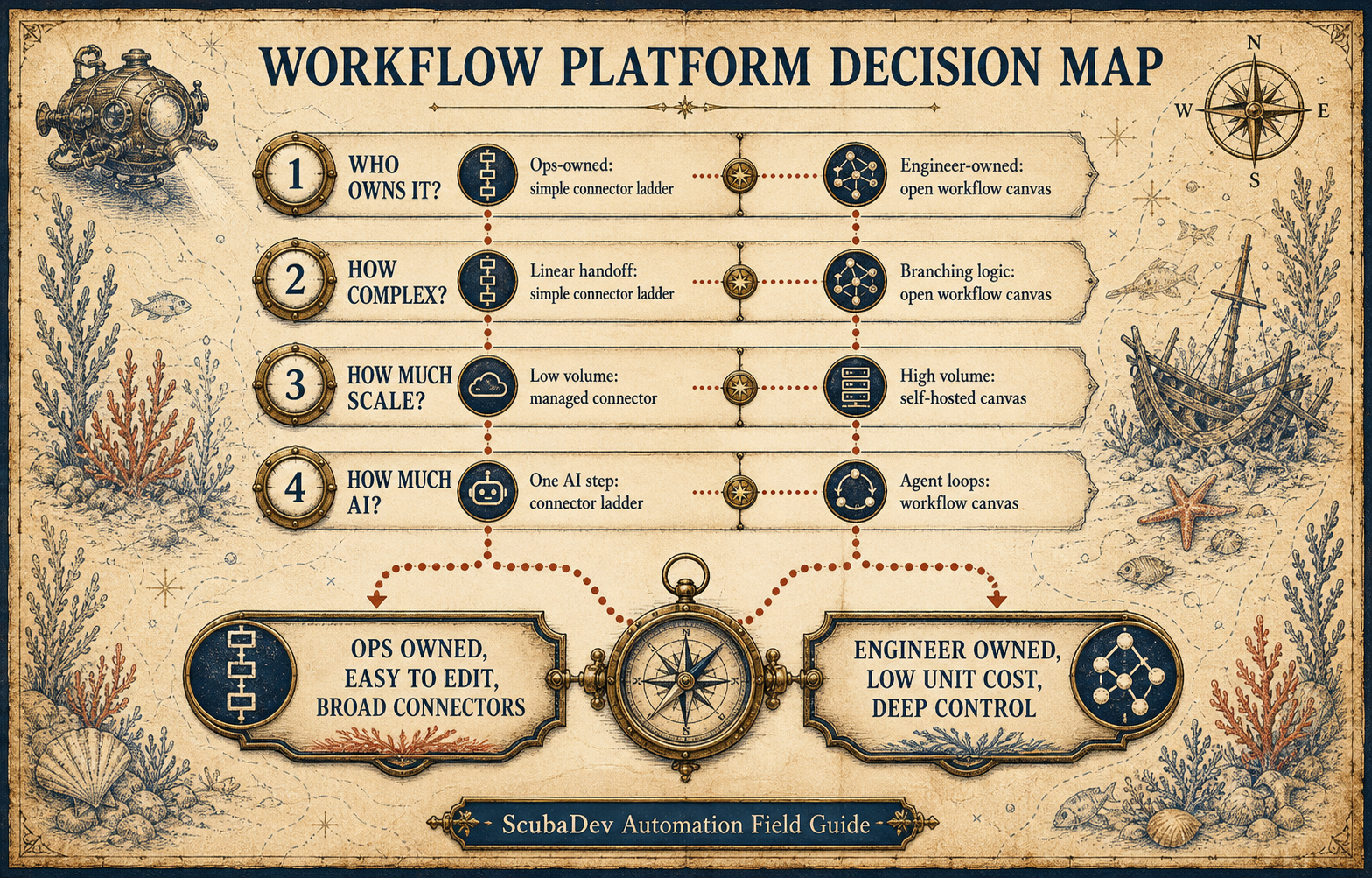


01 / Decision context
Where the comparison matters
Four situations decide most n8n versus Zapier debates before pricing even enters the room. Agencies and SaaS teams usually need n8n because they own scale and code. Operators usually need Zapier because they own the maintenance surface.
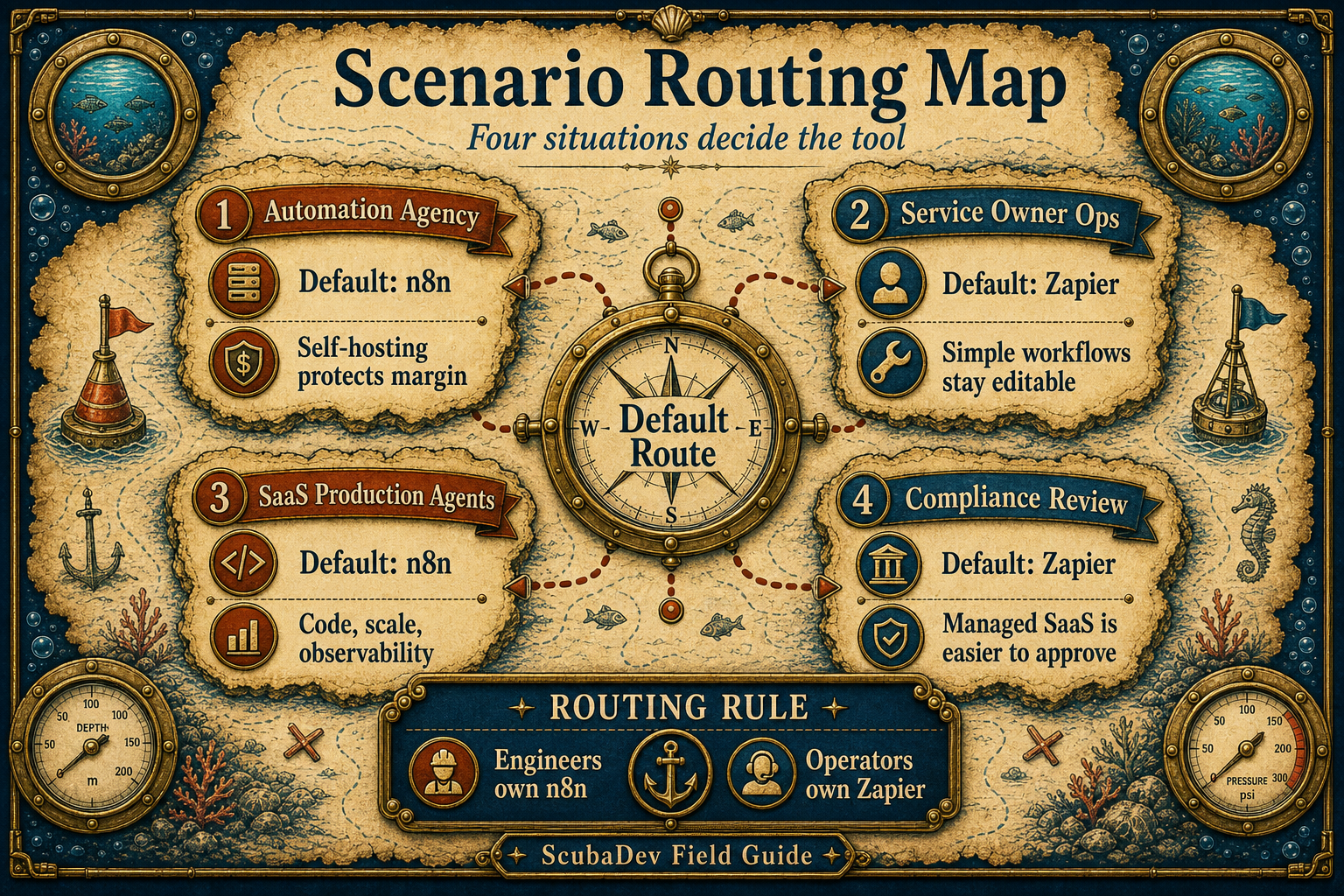
If your situation is obviously one of these, you have your answer. The subtle cases start when a workflow is simple today but will become high-volume, AI-heavy, or too important for an ops-owned Zap.


By the numbers
The production sample behind the routing rule
Production sample
14
Clients in the 2025 to 2026 production sample behind this comparison.
n8n workflows
180
Mostly self-hosted workflows across active client clusters.
Zapier workflows
35
Ops-owned workflows we support but do not need to operate day to day.
Unit advantage
5x
Approximate execution-billing advantage on multi-step workflows before self-hosting economics.



03 / Pricing at scale
The billing unit is the whole comparison
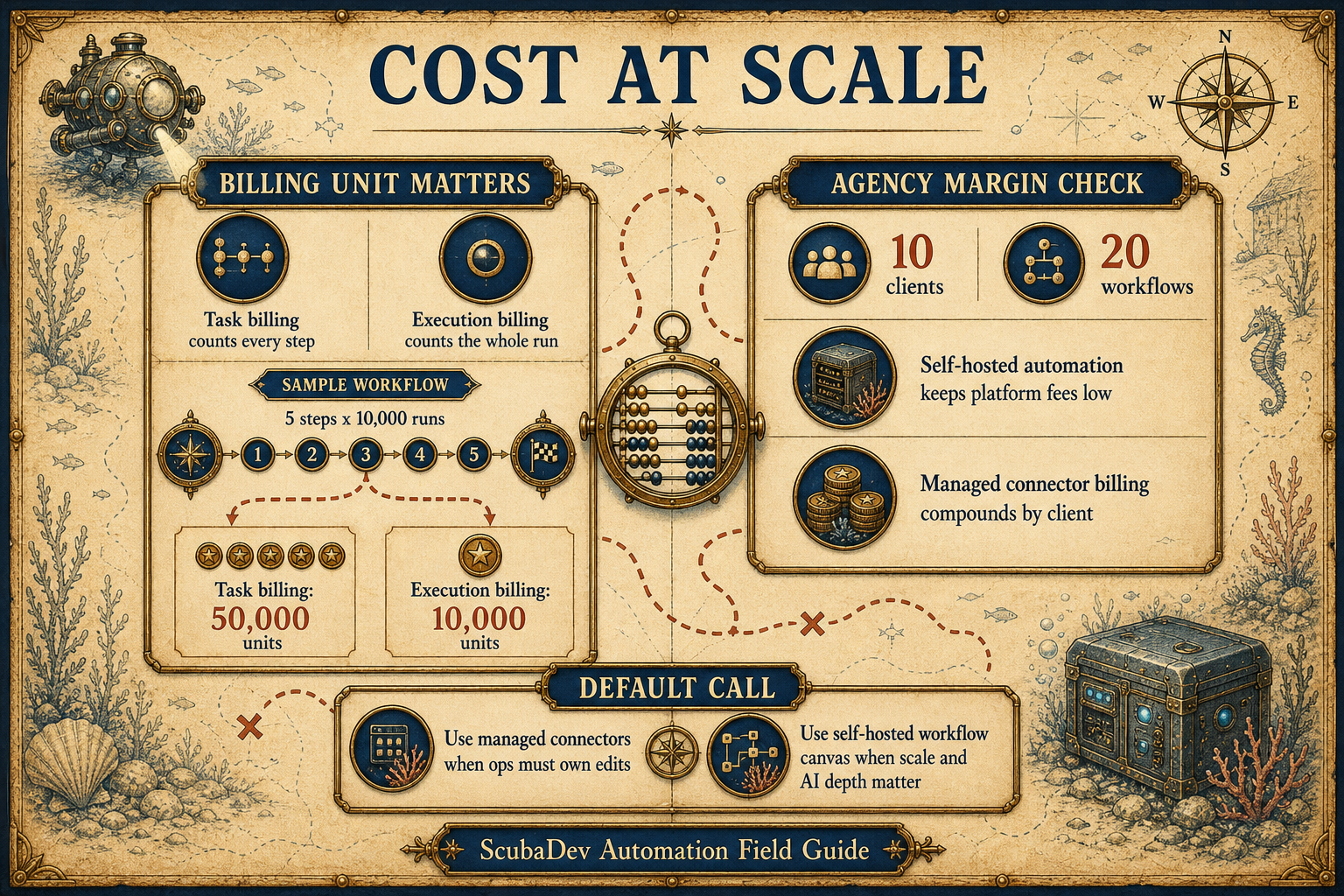
A list-price comparison misses the economic shape. Zapier bills each task step. n8n bills each workflow execution on cloud, and self-hosted n8n bills mostly as server cost.
| Platform | Billing unit | Source example | Field note |
|---|---|---|---|
| Zapier | Task step | A 5-step Zap running 10,000 times consumes 50,000 tasks. | Task cost compounds across clients and can destroy agency margin. |
| n8n Cloud | Workflow execution | A 15-step workflow running 10,000 times consumes 10,000 executions. | The execution model favors multi-step workflow density. |
| Self-hosted n8n | Server and database | Source example lands near $150 per month for a client cluster. | Operational discipline matters, but platform margin improves sharply. |


The five capability checks
After ownership and pricing, the rest of the comparison is capability fit. Each row maps directly to the source sections on integrations, developer experience, AI support, latency, and observability.
- 01
Integration breadth
Zapier wins on native app coverage. n8n closes the practical gap with HTTP Request, but only when someone is willing to write API calls.
- 02
Developer experience
n8n wins for code nodes, JSON workflow exports, version control, self-hosting, and internal-only APIs.
- 03
AI agent and LLM support
Zapier is fine for automation plus one AI step. n8n is stronger for agent loops, memory, tools, vector stores, and model routing.
- 04
Latency and throughput
Zapier is acceptable for most back-office workflows. Self-hosted n8n is the pick when a webhook needs to respond under 2 seconds.
- 05
Observability
n8n execution replay, input, output, error state, and re-runs make production debugging faster for engineering-owned workflows.


05 / Where each breaks
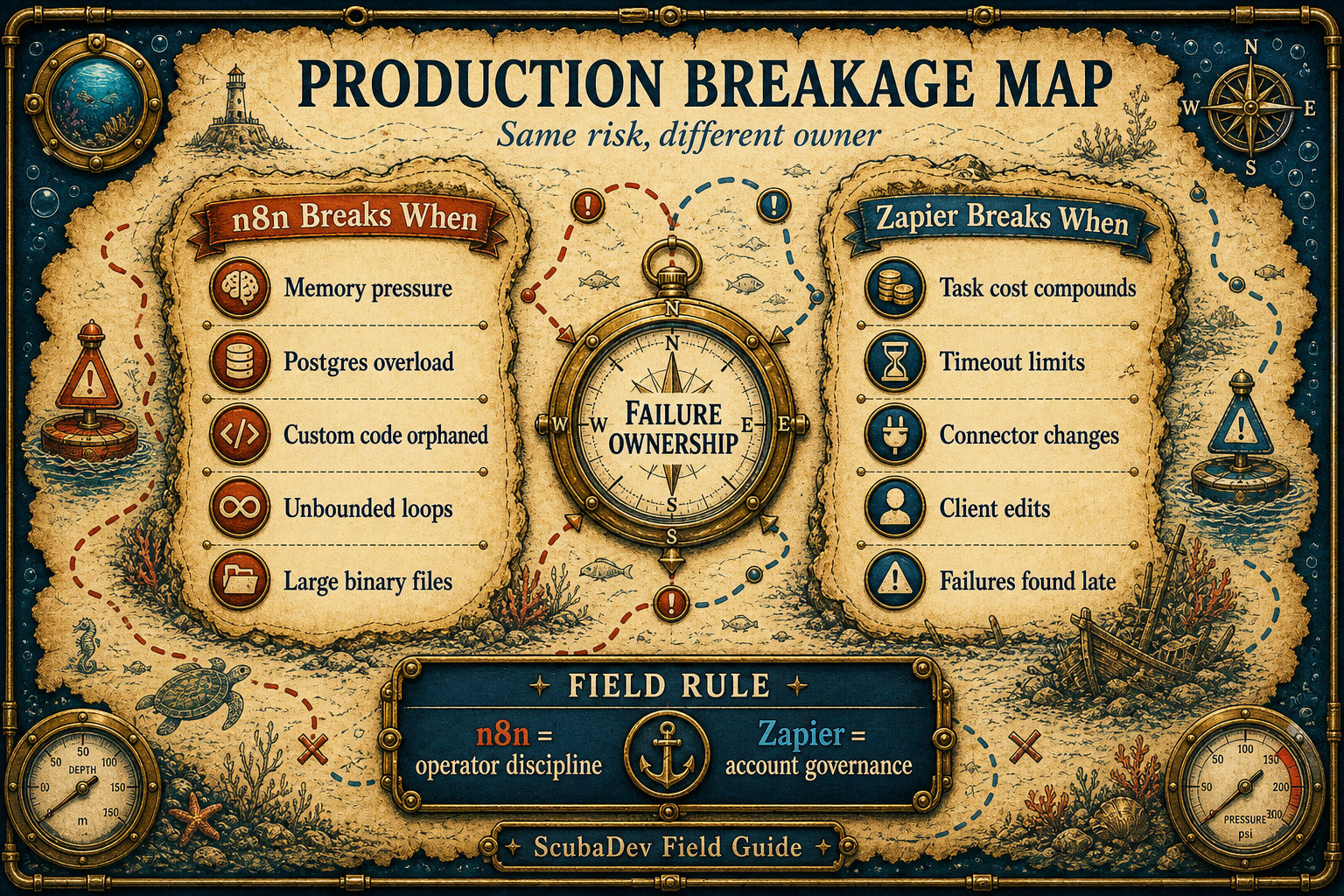
Different platforms, different failure modes
The source point is not that one tool is fragile. Both ship production work. The difference is whether your team is responsible for operating the platform or for governing a managed SaaS account.
Six workflows and where each belongs
These examples come from the source ideas library and map the comparison back to real operational patterns.
- 01
Publishing workflow with schedule
n8n wins. Rollback logic, conditional branching, state tracking, and file operations push this beyond Zapier's clean lane.
- 02
Approval chain with tiered limits
Zapier is fine. Linear approvals with conditional paths and common integrations can ship quickly when ops owns the workflow.
- 03
Multi-step deal review
n8n wins. SLA tracking and custom logic get hard to read in Zapier once the workflow grows past a few steps.
- 04
Contract review workflow
Build custom. Use n8n as orchestration glue, but document state belongs in a custom app or state machine.
- 05
Vendor onboarding workflow
Zapier wins if ownership is non-technical. The logic is modest and the integration surface is broad.
- 06
Quote approval workflow with margin gate
n8n wins. Margin calculation and rule-engine logic are cleaner in a code node than a chain of filters and formatters.


FAQ
Is n8n really free?
A: Self-hosted n8n is free under the Sustainable Use License for your own business. Free still means you operate and pay for the server, database, monitoring, and backups.
Is Zapier more reliable than n8n?
A: Zapier Cloud beats a poorly run self-hosted n8n instance. A well-run self-hosted n8n stack can be more reliable for your workflow because you control infrastructure, retries, and observability.
Can non-developers build on n8n?
A: Yes for simple workflows. Once a workflow needs code nodes, loops, custom error handling, or API nuance, n8n becomes a developer-owned tool.
What about Pipedream, Activepieces, or Windmill?
A: Pipedream is code-first and strong for developers. Activepieces is the leading open-source Zapier clone. Windmill is closer to a script runner. For most small teams, n8n or Zapier is still the first decision.
Which scales better?
A: Self-hosted n8n scales best because you control infrastructure. Zapier scales within plan limits, but task economics get expensive as workflow volume and step count increase.
Should I use both?
A: Yes. Most real ops stacks have both. n8n is for complex workflows engineers own. Zapier is for simple workflows ops teams own.