




An AI automation agency designs, builds, and operates production AI workflows: LLM agents, n8n pipelines, MCP tools, voice agents, and multi-step automations that run under human review.
The real category is not a Zapier reseller with a new logo. The difference is production discipline: version control, observability, rollback, token-cost control, and a team that keeps the system alive after launch.
Pricing is $3,000 to $20,000 per month on retainer, or $8K to $60,000 one-time for a discrete build. The real ones use n8n, GPT-5.5, Claude Opus 4.7 and Sonnet 4.6, MCP servers, typed tools, observability, rollback, and token-cost controls under human review.
Below the surface
AI automation agencies in 2026 are not idea shops or Zapier resellers with a new label. The useful ones ship production workflows: LLM-powered agents, n8n pipelines, MCP tools, voice automation, monitoring, rollback paths, and human review where the workflow can hurt the business. This post covers what they actually do, what they cost, and how to separate a real build partner from a demo vendor.


By the numbers
The AI automation numbers buyers should know
-
Monthly retainer
$3K to 15K
Common monthly range for run-and-iterate automation work.
-
Workflow build
$8K to 60K
Typical one-time range for a scoped workflow or multi-step agent build.
-
Common agents
5
The repeatable agent patterns we see most often across small teams.
-
First version
2weeks
A focused internal workflow can usually reach a reviewed first version fast.




01 / Agency model
What an AI automation agency actually ships
The category covers three distinct kinds of engagement. Treat them as separate services because the skills and pricing do not overlap.
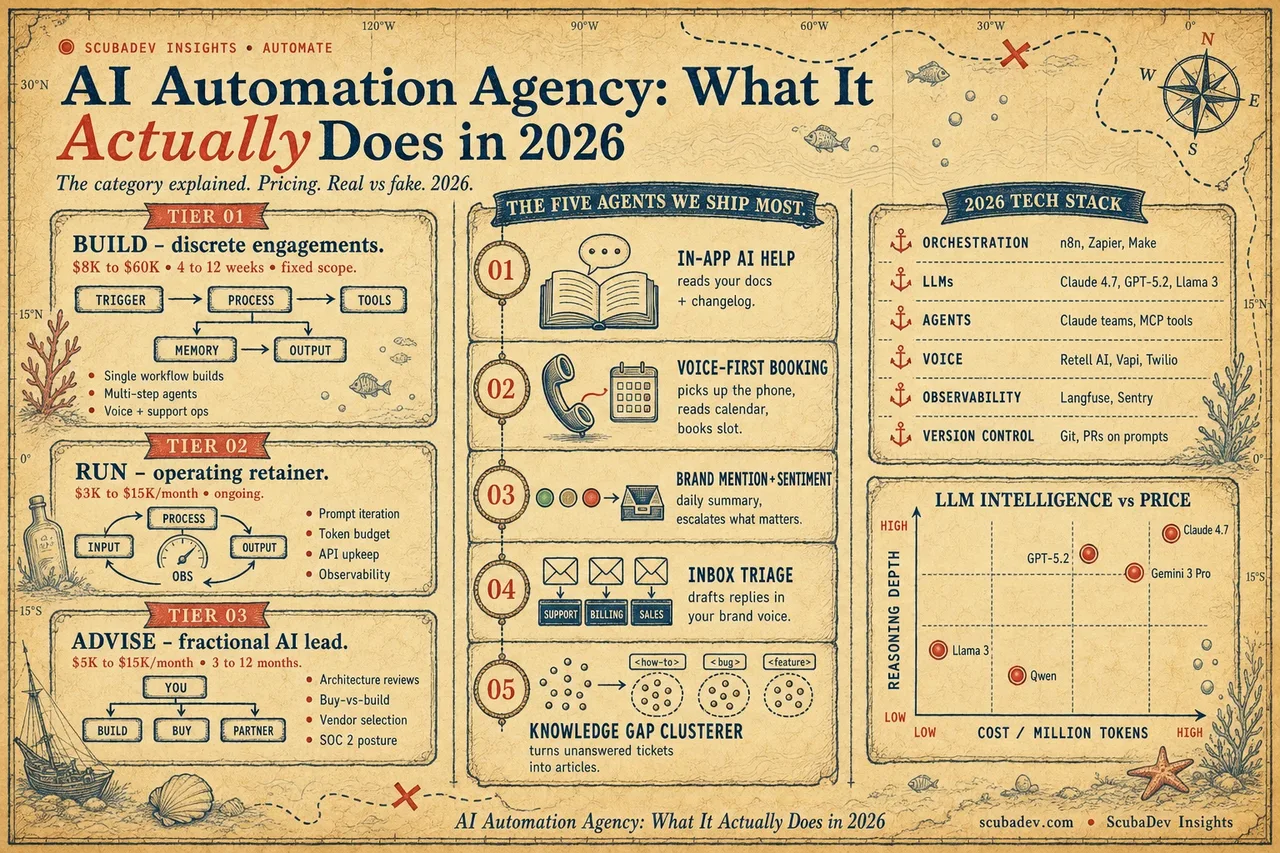
Build is a fixed-scope AI system. Run is the ongoing operating retainer. Advise is the implementation leadership layer for vendor selection, architecture, security, and build-buy decisions.
A real AI automation agency can do all three. A Zapier reseller can do build only, and only for simple automations.
02 / Services
Build, run, and advise are different jobs
Build
A fixed-scope AI system. Examples: an inbox triage agent that reads every new support message and drafts a reply in your brand voice, a voice-first booking agent that answers the phone and books appointments off the team calendar, or a knowledge base gap analyzer that clusters unanswered tickets into missing articles. These are typically 4 to 10 week engagements priced $8K to $60K.
Run
An ongoing retainer to operate the systems the agency built. Includes monitoring, token-cost management, prompt iteration, integration upkeep when APIs deprecate, and adding new workflows as the client asks. Pricing is $3K to 15K per month. This is the part most "AI automation agencies" skip and why their builds fall over in month three.
Advise
An AI implementation consultant role. Architecture reviews, build-buy-partner decisions on AI features, vendor selection across the LLM stack (Anthropic, OpenAI, Google, Meta, and open model providers), and sometimes SOC 2 and security posture for AI systems. Priced like fractional engineering, $5K to $15K per month.


The May 2026 tech stack
This is the stack we run at ScubaDev and see across the handful of other operational plays in the space. Last reviewed May 2026.
- 01
Orchestration
n8n remains our production orchestration default because self-hosting, retries, credentials, and version control matter. Lighter hosted automation tools still belong in quick internal glue, not mission-critical agent workflows.
- 02
LLMs
As of May 2026, we route reasoning-heavy work to Claude Opus 4.7 or Sonnet 4.6, use GPT-5.5 for OpenAI-native product work, vision, tools, and platform fit, and keep open models such as Llama or Qwen in the mix where infra control or unit cost matters.
- 03
Agent frameworks
The framework layer changes faster than the model layer. Our default is direct API calls, MCP servers, typed tools, and small workflow-specific agents. We only use heavier agent frameworks when they remove real orchestration work.
- 04
Voice
Voice workflows still need a telephony layer, transcription, a current reasoning model, and an escalation path. We treat the model as swappable and keep the phone, CRM, and handoff logic stable.
- 05
Observability
Production AI automation needs traces, prompt and tool versioning, rollback, evals, and token-cost alerts. The stack changes, but the operating discipline does not.
- 06
Version control
Agents run in repos. Prompts live in repos. Pull requests get reviewed. Teams without this discipline ship, then silently break, then disappear.
If an agency pitches you and cannot tell you what their observability stack is, they do not have one.


What the real costs look like
Public and ScubaDev-observed ranges, last reviewed May 2026:
| Model | Rate | Time to start | What you get |
|---|---|---|---|
| Single workflow build | $5K to $15K | 2 to 4 weeks | Scoped automation wired into source systems |
| Multi-step agent | $15K to $60K | 4 to 12 weeks | Agent with tools, memory, and review |
| Automation retainer | $3K to 15K per month | Ongoing | Monitoring, repair, and iteration |
| AI implementation consulting | $5K to $15K per month | 3 to 12 months | Strategy, governance, and vendor selection |
| Enterprise AI program | $30K to $100K per month | 6 to 24 months | Program design and implementation |
How to tell a real agency from a Zapier reseller
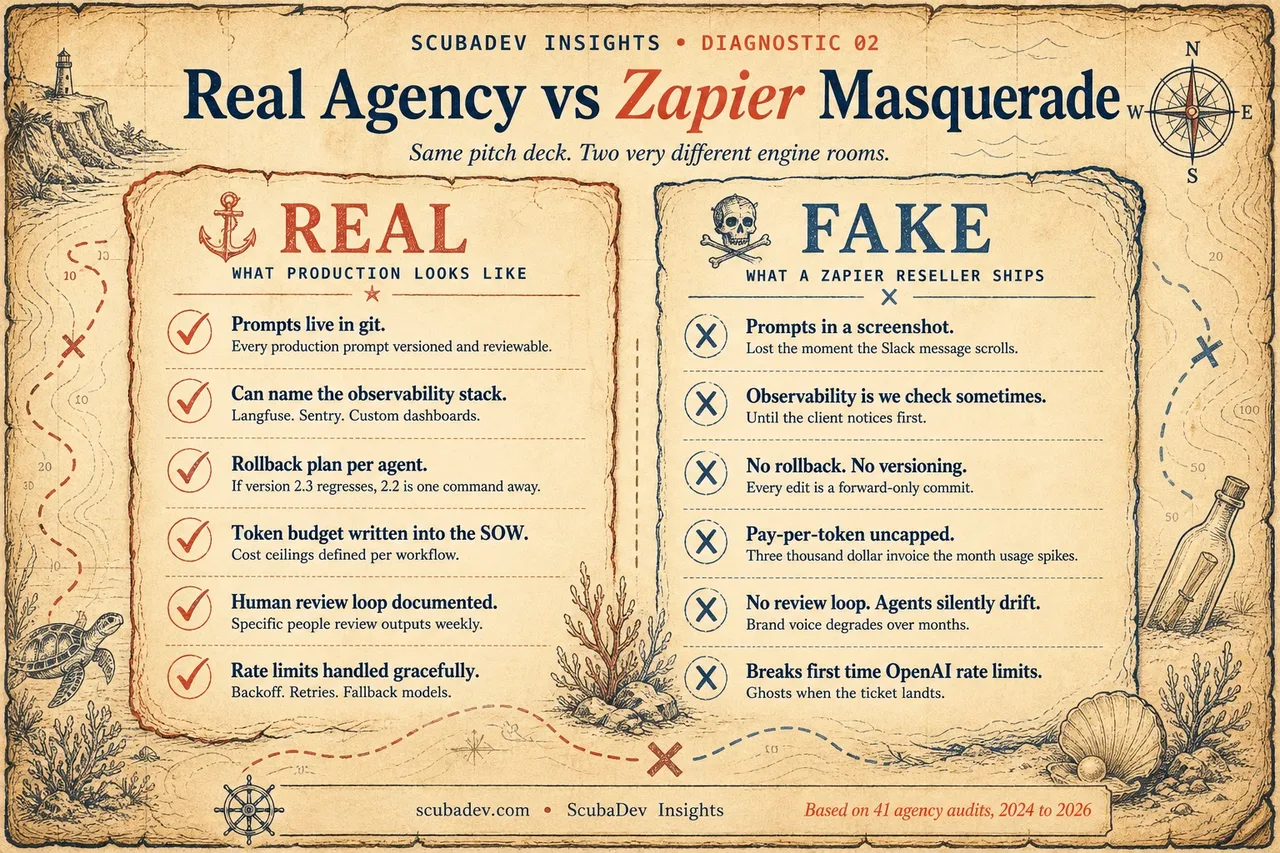
Six questions separate the categories. Ask these on the first call, in this order.
- 01
What is in your repo?
A real agency runs prompts, agent logic, and workflow definitions in git. Resellers run everything in the Zapier UI and have no version history.
- 02
How do you do rollback?
Real answer: branch, PR review, deploy to staging, promote. Reseller answer: "we make a copy of the Zap before changes."
- 03
Token cost projection for this build
Real agencies can model token spend per workflow to within 30 percent. Resellers cannot, and that is why the first token blowout burns the retainer.
- 04
What is your on-call process?
Real agencies have one. Pager duty, a runbook, a rotation. Resellers answer "we will fix it when you flag it."
- 05
Show me an error log triage workflow
This is a basic observability workflow every agency should run on itself.
- 06
What broke last month, and how did you fix it?
Real agencies have an answer. This is a reverse-interview of their incident response.
05/COMMON AGENTS
The five agents we build most
These are the workflows we ship most often across ScubaDev retainers. Every one maps to a live idea in our ideas library you can clone.
-
01 / In-app AI help that reads your product docs
Users ask questions in the app. The AI answers from your actual product docs. Unanswered questions flow to support.
EffortMomentum, 2 to 3 weeksPaybackUnder 30 daysStackDocs retrieval + LLM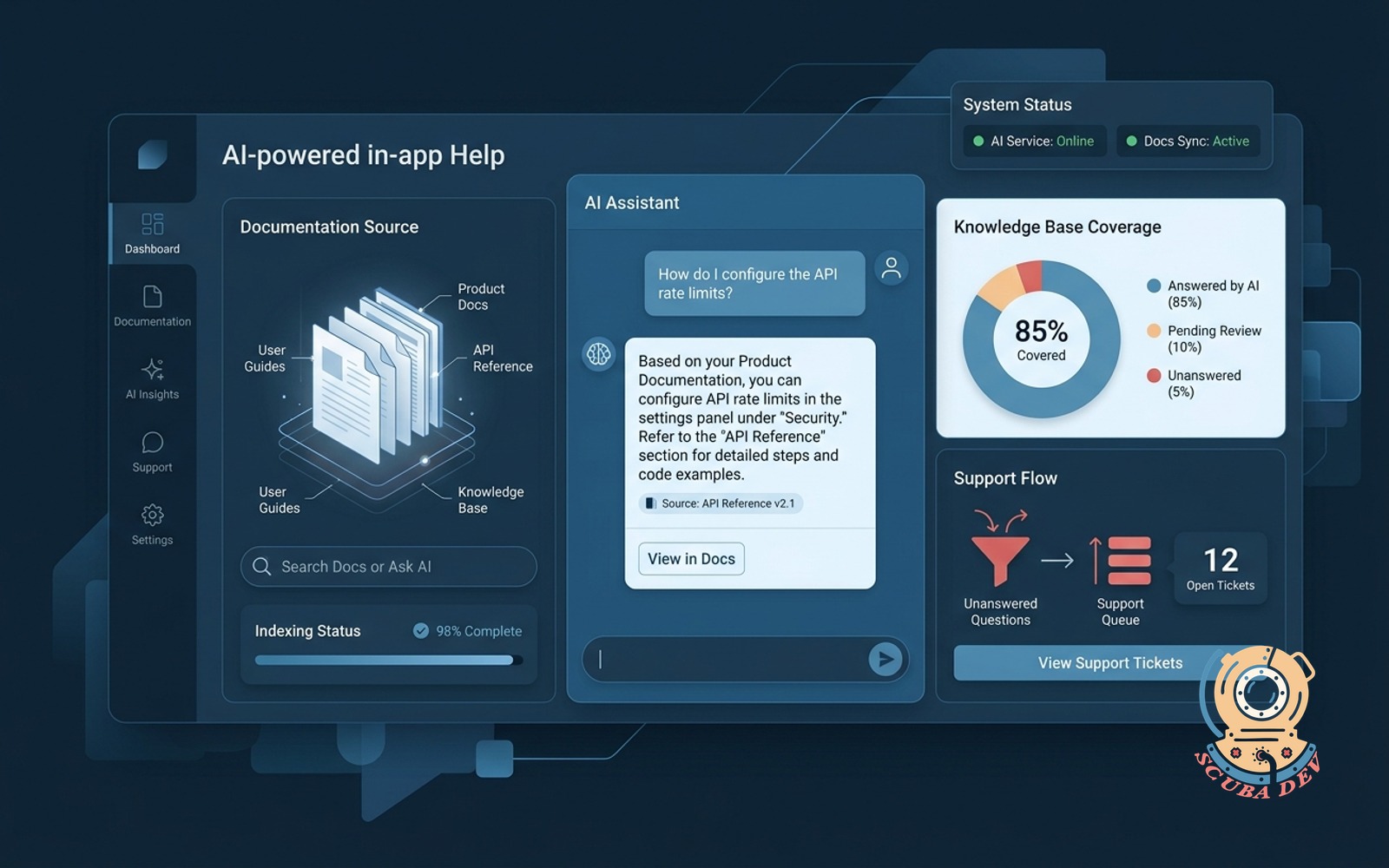
The in-app AI help blueprint is the most requested pattern by far. A chat widget inside your SaaS product. User asks a question. The agent answers from your product documentation, help center, and changelog. If the agent cannot answer, the message routes to support with context preserved. Token-cost is bounded because the agent only reads docs, not the whole web. It ships fast because there is no new UI outside the widget, no new auth surface, and most product docs are already in a format an agent can ingest.
-
02 / Voice-first booking agent
Answers the phone, reads team calendars, books the right service with the right person, and sends a confirmation text.
EffortDepth, 4 to 6 weeksPayback30 to 60 daysStackRetell or Vapi + Twilio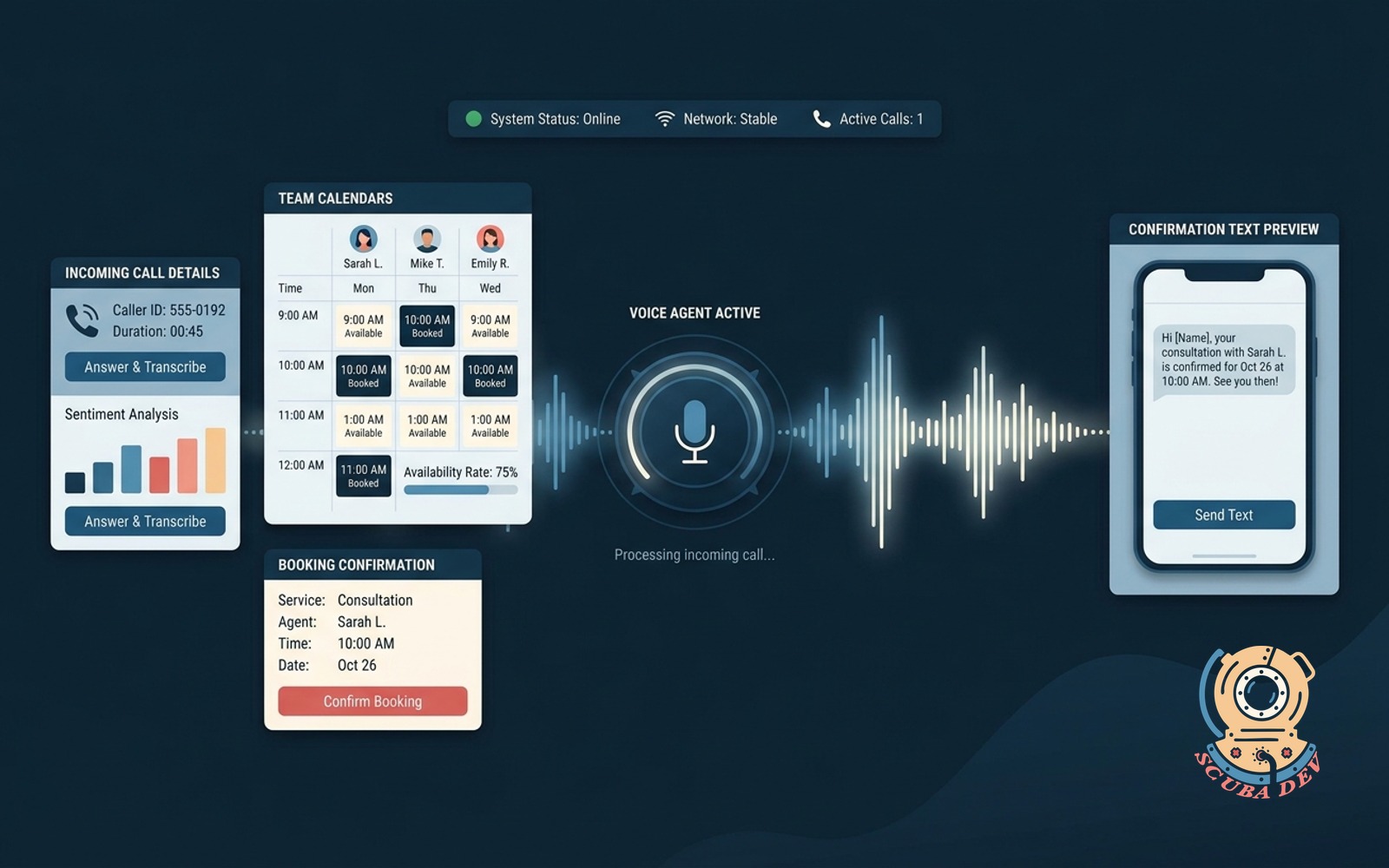
The voice-first booking agent picks up the phone, asks what the caller needs, reads the team calendar, picks the right service and person, books the slot, and sends a confirmation text. This is what we built for Mermaid Phone. The pattern generalizes to any service business with calendar-driven booking. Retell AI handles the voice layer, Twilio handles the phone number, a current reasoning model handles the call logic, and the booking surface is picked from what the client already runs.
-
03 / Brand mention agent with sentiment
Watches the web and social for your brand. Summarizes daily, flags negative mentions for response.
EffortMomentum, 2 to 3 weeksPayback60 to 90 daysStackn8n + custom classifier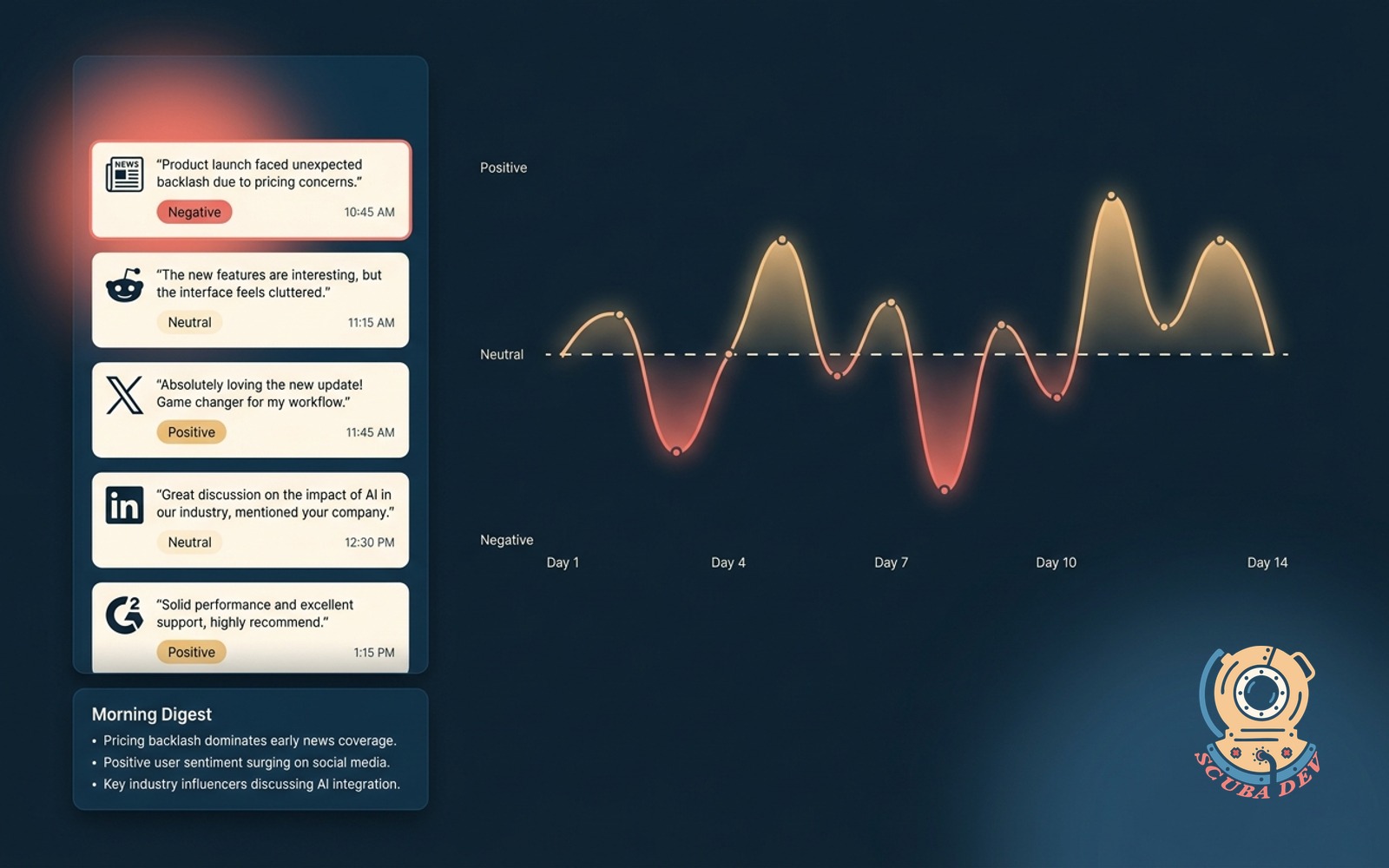
The brand mention agent with sentiment watches the web and social for your brand, summarizes daily, and flags negative mentions for a human to respond to. The monitoring surface is the commoditized part. The value is sentiment classification, summary, and routing logic that only escalates what matters. The flag-only-what-needs-a-human rule is the difference between a tool they use and a tool they turn off in month two.
-
04 / Inbox triage agent
Reads every new message, drafts the reply in your voice, files the rest, flags only what needs you.
EffortMomentum, 2 to 3 weeksPaybackUnder 30 daysStackTwo-stage LLM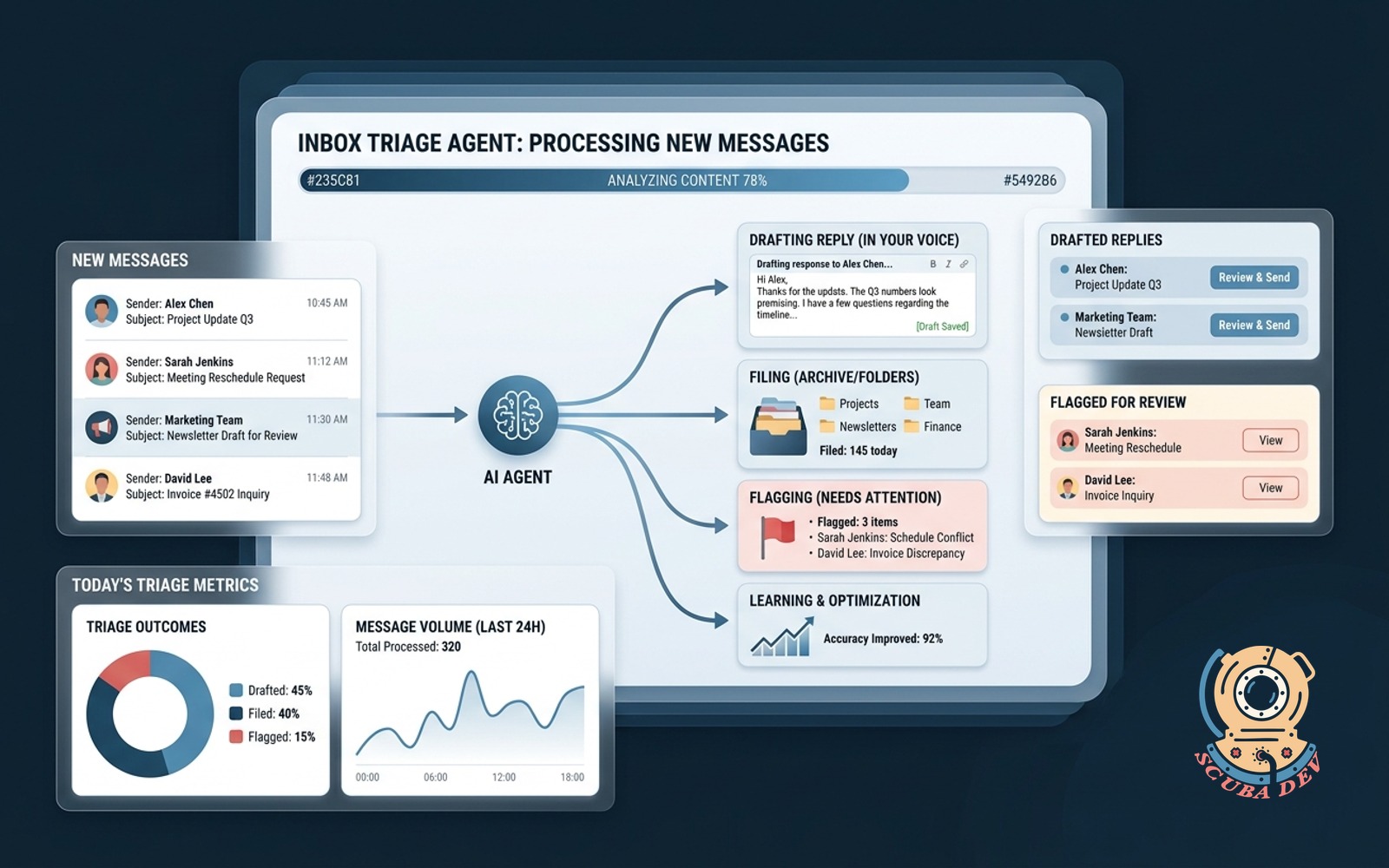
The inbox triage agent reads every new message in an inbox, drafts the reply in your voice from your past-sent-mail pattern, files routine replies, and surfaces the few messages that need you. This is the single highest-ROI agent for operators whose inbox is the bottleneck. We use a two-stage classifier: a cheap model does first-pass categorization, a more capable model drafts the reply, and the system asks for approval on anything outside a known pattern.
-
05 / Knowledge base gap analyzer
Clusters unanswered tickets into topics the knowledge base does not cover. Drafts the missing articles for approval.
EffortMomentum, 2 to 4 weeksPayback60 to 90 daysStackEmbedding clusters + LLM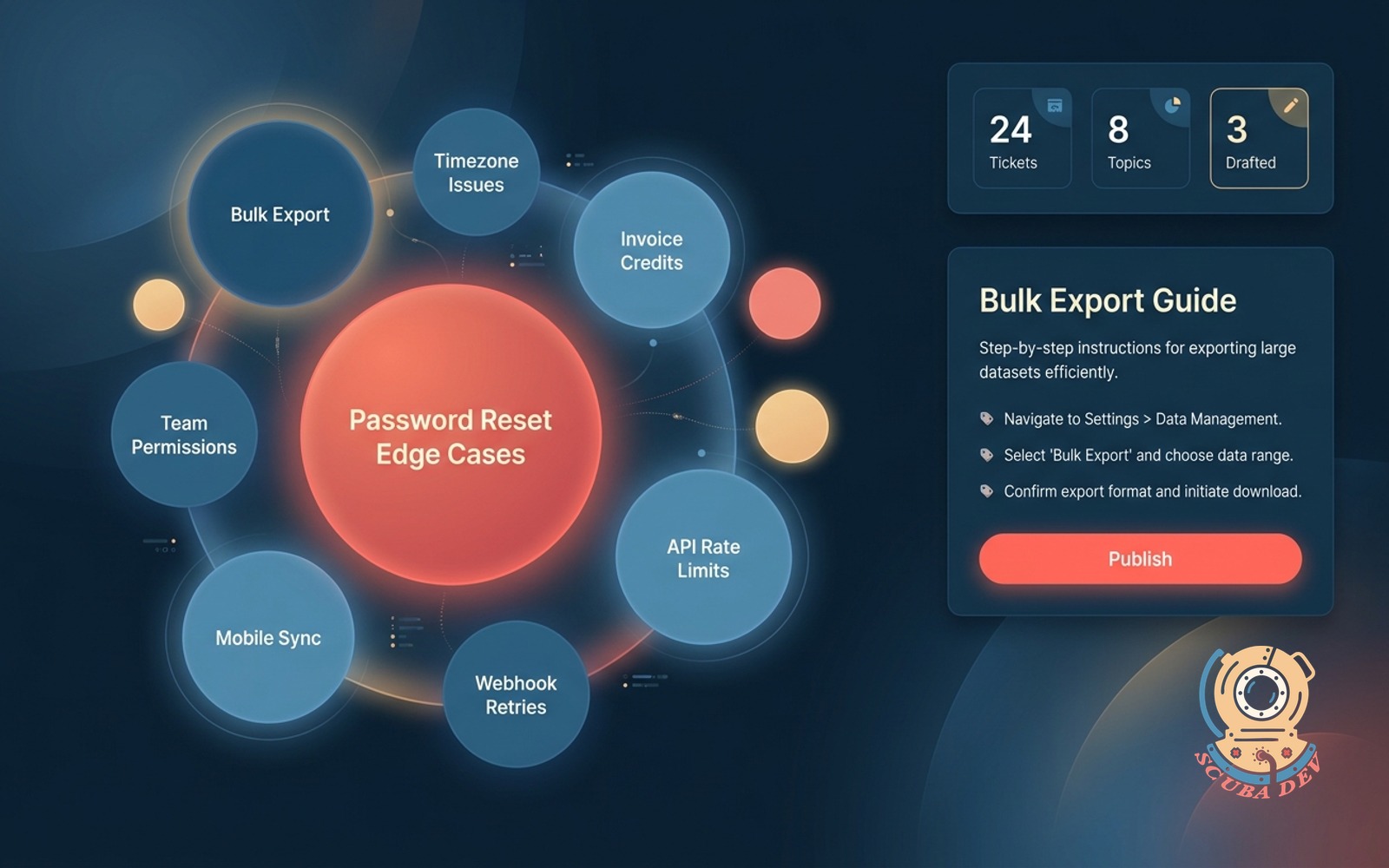
The knowledge base gap analyzer clusters unanswered support tickets into topics your documentation does not cover, and drafts the missing articles for approval. It closes the loop on in-app AI help. The output is a practical backlog from real support demand and a trend line of repeat-question volume going down. We ship this alongside in-app AI help, and the pair cuts support load by 40 to 70 percent within 90 days in the deployments we can measure.


FAQ
Is an AI automation agency the same as an n8n agency?
A: Close, not identical. An n8n agency is a subset. AI automation agencies cover agent frameworks, LLM APIs, voice, and custom code in addition to n8n. n8n is the workflow layer, not the whole job.
Can I just use Zapier plus ChatGPT?
A: For simple glue, yes. For anything that needs memory, multi-step reasoning, voice, or cost discipline, no. The line is usually around 5 steps or any workflow that calls an LLM more than once per execution.
What is the typical retainer?
A: The current range is $3K to 15K per month for ongoing run-and-iterate work. The low end is a single workflow and routine iteration. The high end is 5 to 10 production workflows with observability and monthly additions.
Do AI automation agencies work with small teams?
A: Yes. The agencies that do well in this category serve 5 to 50 person service businesses and early-stage SaaS. Enterprise AI is a different category with different pricing.
What is the difference between build and run pricing?
A: Build is fixed-scope, shipped in weeks. Run is a monthly retainer to operate and iterate. Most real agencies require run after build, because unsupervised AI systems silently break.