




Productized engineering is a single offer at a single price with a single scope. Hourly agency pricing punishes clients for good outcomes and punishes agencies for being efficient. Subscription pricing wins on every axis a buyer cares about.
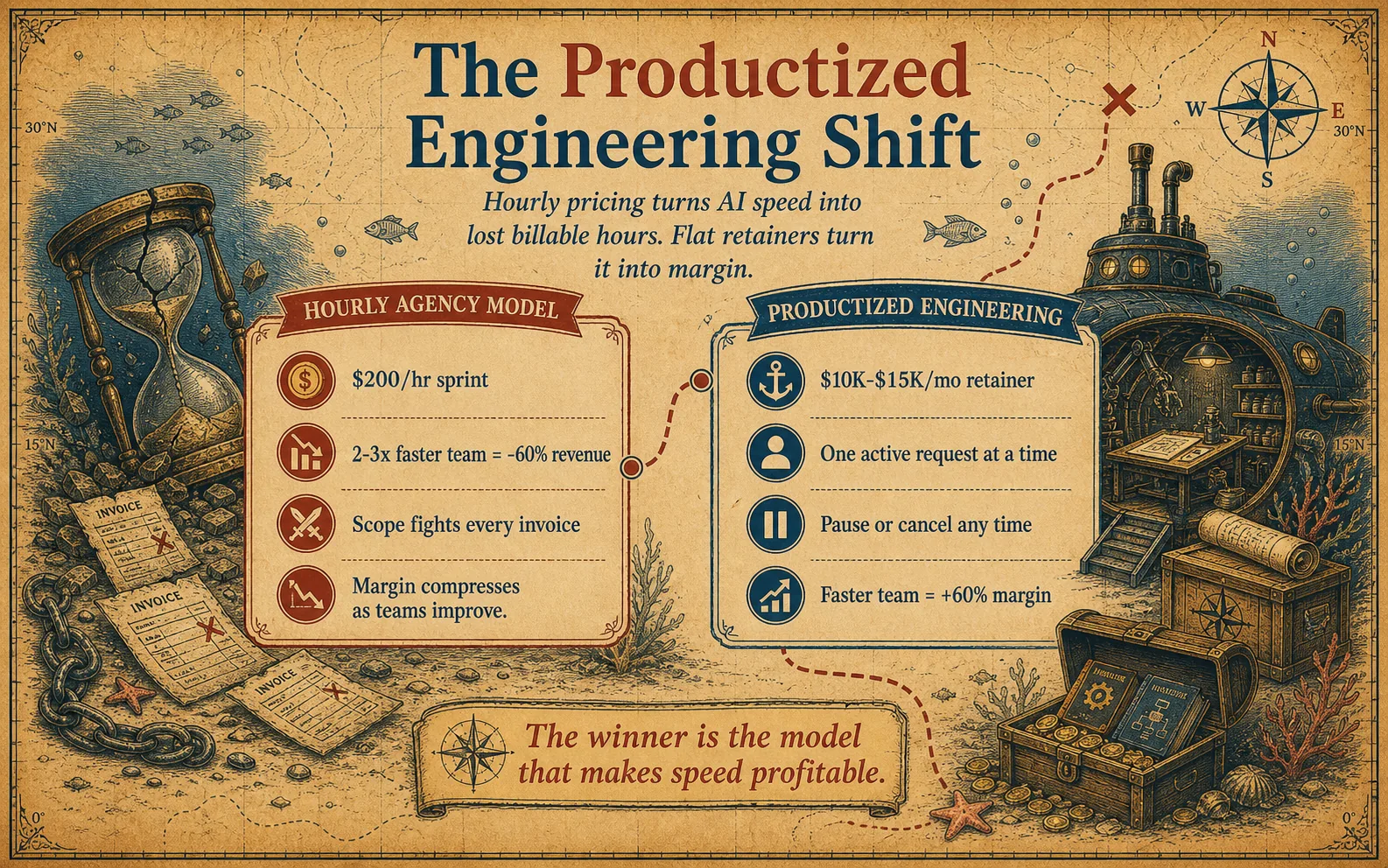
Subscription dev studios are landing $10K to $15K per month flat-rate retainers and the clients who used to pay $200 per hour are not coming back. This is a structural pricing shift, not a preference.
Agencies that do not convert to flat rate will lose their dev-heavy retainers first, then their website and automation work, then their creative. We are building ScubaDev around this thesis, so consider the bias.
Below the surface
Productized design subscriptions proved that a single designer on a $5,000 per month plan could do $1.5M in ARR without a single time sheet. Subscription dev studios are now doing the same trick in engineering, with team-based plans landing in the $10K to $15K per month range. The clients who used to pay hourly agencies $200 an hour for a 40-hour sprint are moving to flat monthly retainers and they are not coming back. This is not a design preference. It is a structural pricing shift, and the traditional agency model does not have an answer for it.


By the numbers
The pricing math buyers and operators should know
-
Hourly anchor
$200 /hr
Senior agency rate clients used to pay for a 40-hour sprint.
-
Subscription anchor
$11K /mo
Industry anchor price for a flat-rate engineering retainer.
-
AI throughput
2 to 3x
Per-hour output of a 2026 senior with Claude Code versus 2022.
-
Margin swing
60 %
Hourly: revenue cut. Flat-rate: margin expansion. Same shop, same AI.






01 / The diagnosis
Why hourly pricing is already broken
At its core you are selling people’s time. Ryszard Szopa wrote the canonical Medium post about this in 2015 and the economics have not changed in a decade: when your revenue is hours times rate, margin compresses every time a team gets faster, every time AI makes a task shorter, and every time a client questions a line item. You cannot ship a faster team on hourly pricing without cannibalizing yourself.
The client side is even worse. Hourly contracts encourage scope creep fights because every new request is a new line item to negotiate. They punish the client for having good questions because the clock is running. They punish the agency for being efficient because the faster you ship, the less you bill. Both sides know this. Both sides pretend it is fine. It is not fine.
AI tooling makes it actively hostile. In 2026 a senior engineer with Claude Code and a well-tuned CLAUDE.md ships roughly 2 to 3 times the output per hour of a 2022 senior engineer. On hourly pricing that is a 60 percent revenue cut. On a flat retainer that is a 60 percent margin expansion. Guess which pricing model attracts talent.
02 / The category
What productized engineering actually is

Removes the negotiation
A single offer at a single price with a single scope. One active request at a time, unlimited revisions, pause or cancel any time, around $11K per month. No rate card, no change order, no scope debate. Client sends a request. Team queues it. Team ships it. Client either loves it or pauses their subscription.

Aligns the velocity incentive
The team is rewarded for shipping faster. Faster shipping lets them take more clients at the same headcount, which is the whole margin story. Clients are rewarded because their backlog moves. Hourly pricing penalizes both sides for speed. Subscription pricing rewards both sides for it.

Forces a system, not a service
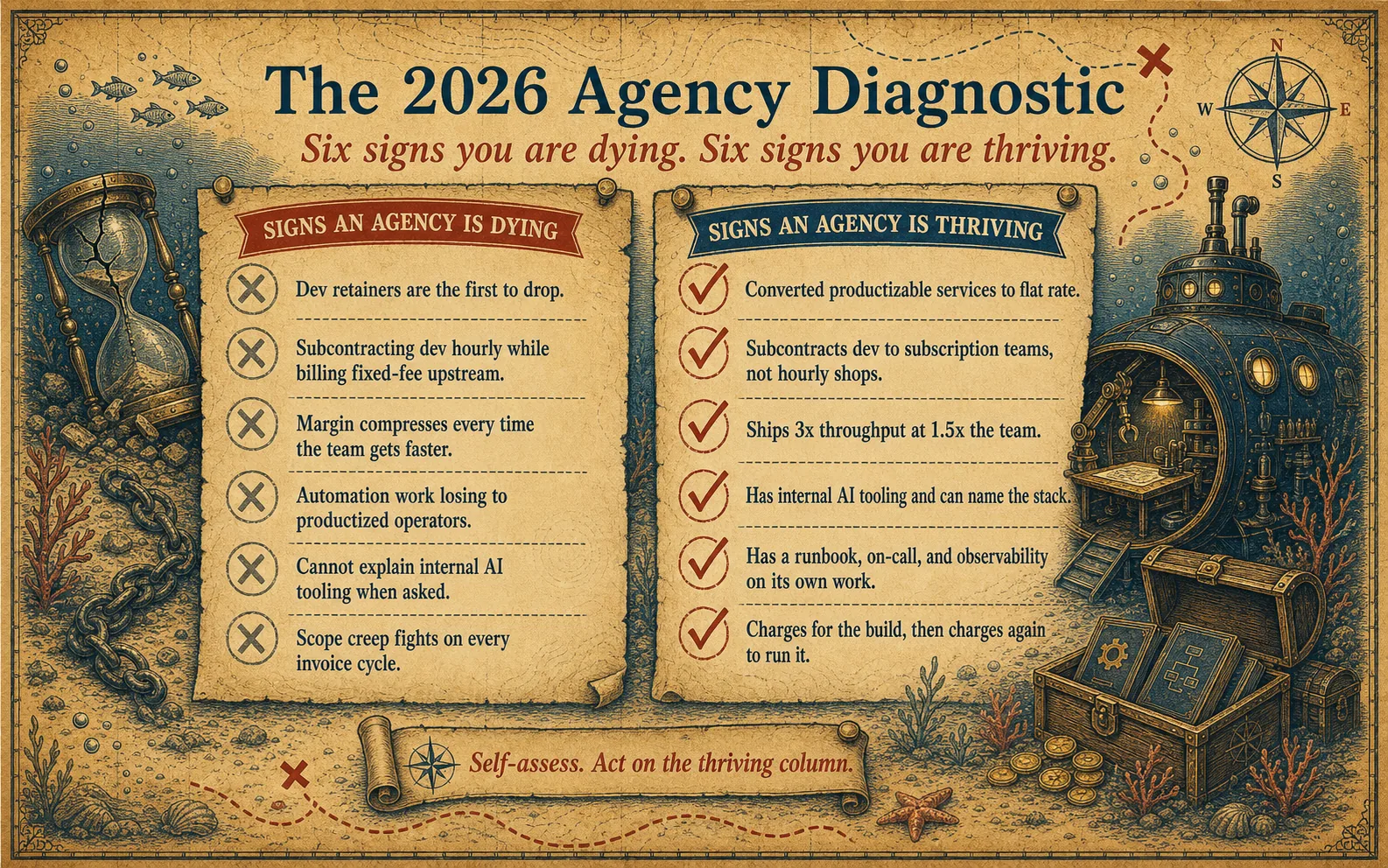
You cannot run a productized offer at scale without templates, playbooks, internal tooling, and AI-first workflows. The agencies that cannot build those systems die. The agencies that can run 3x the throughput at 1.5x the team.


Why engineering is next
Design went first because the work is atomic. A logo, a landing page, a brand system: each is a bounded artifact. Engineering held out longer because “build me a SaaS” is not atomic. Three things changed that.
- 01
AI made the work atomic
Claude Code, Cursor, and Opus 4.7 subagent pools turned “build me a feature” into a bounded spec, a PR, and a review. Spec-driven development made the atomic unit smaller. See our context engineering piece for the specific patterns.
- 02
Subscription precedent trained the market
Productized design subscriptions have crossed $1.5M ARR on a single-operator model, and the leading subscription dev studios have crossed $1M ARR in engineering. Every design-adjacent operator has seen the spreadsheets. Every founder has done the math. Our fractional CTO primer lays out the specific numbers that make a 20 percent equity co-founder look like a mistake.
- 03
Agency margins got worse
Per Quantum Agency’s 2025 Profit Crisis report, agencies outsourcing 40 to 60 percent of delivery grow 2.3x faster and report 20 percent higher margins than pure in-house. Flat-rate subcontractors give agencies margin and velocity at the same time. Hourly subcontractors give them neither.




What agencies will lose first
Three prediction calls. Flag them as opinion.
- 01
Dev-heavy retainers
Agencies that won a web, app, or automation retainer on the strength of their full-service pitch and then subcontracted the dev at an hourly rate now have a new option: subscribe to a flat-rate engineering team. We are already seeing this conversion. We flip around three agencies a quarter from hourly Upwork sub arrangements to flat monthly retainers with us. The agencies who do this keep their client. The agencies who do not lose the client to a direct relationship with the subscription team.
- 02
Website and automation work
Agencies charging $30K for a marketing site that took the subscription team two weeks are already uncompetitive. Automation work is next, because n8n plus AI agents plus a playbook like the AI Automation Playbook collapse a $15K custom build into a 4-day sprint.
- 03
Creative direction on software
The subscription model does not only ship code. It ships design decisions, architecture opinions, and roadmap input. Agencies that thought they owned the creative lead because they owned the brand relationship are learning that clients will move the creative lead to whoever is shipping. Whoever ships decides.



What this means for agency owners and founders
Two moves for owners. One frame for non-technical founders shopping the market today.
- 01
Convert your own pricing to flat rate wherever possible
Start with the productizable services: sites, automations, reporting, content systems. Price a single offer at a single rate with a single scope. Lose the custom-quote revenue that cannot convert. Keep the custom-quote revenue that is truly bespoke.
- 02
Partner with a subscription engineering team for dev work
Not with hourly subcontractors. This is not self-promotion, it is math. The agencies that win this decade will be the ones who subcontract on the same pricing model they use themselves. Our Build engagement model is designed for this pattern.
- 03
For founders: stop shopping $200 per hour contractors
If you have been priced out of $200 per hour contractors and shopped around $150K full-stack hires, the productized engineering market is now the sanest option. You can get a senior engineering team shipping features every week for less than the loaded cost of one full-time engineer, and you can pause or cancel in a bad month. Go read our subscription dev category piece for the full breakdown.
The counter-argument
Three cases where subscription pricing breaks
Subscription pricing does not fit every engagement. Three cases where it breaks.
- 01 / Enterprise scale
A 12-month migration with dedicated team and SOC 2 scope.
A migration of that size does not fit a “one request at a time” model. It fits staff aug or a true engineering engagement. Pricing there is still flat, it is just flat-monthly-per-engineer, not flat-per-outcome.
- 02 / Cowboy clients
The client wants to direct every keystroke.
Subscription works for clients with a backlog of small, prioritizable requests. Clients who want to direct every keystroke will kill the model. We screen for this in discovery.
- 03 / No system underneath
The agency has not built the systems.
A shop running flat rate without templates, playbooks, internal tooling, and an AI-first stack is running a hot-hourly shop with a subscription billing wrapper. That lasts six months before margin collapses and the team burns out.


FAQ
Is productized engineering the same as a fractional CTO?
A: No. A fractional CTO leads. A productized engineering team ships. Different roles, different prices, usually complementary.
How is this different from staff augmentation?
A: Staff aug assigns named engineers to a client who manages them directly. Productized engineering assigns a team that manages itself and delivers outcomes. The client does not pick who codes.
Will subscription pricing work for enterprise?
A: Parts of it, yes. Enterprise needs dedicated team commitments and long sales cycles. The flat-rate mechanic still works, the sales motion is different.
What breaks a subscription dev team?
A: Bad scope discipline on the agency side and cowboy clients on the buyer side. Both are screenable. Most collapses come from the agency accepting clients that should not have been onboarded.
Is ScubaDev a productized service agency?
A: Yes, we run flat-rate monthly retainers with one active request at a time, pause or cancel any time, and publish our operating system publicly. That is the thesis and we are eating our own dog food.