




A fractional CTO is a senior engineering leader who runs your technical roadmap part time, usually 10 to 25 hours a week, on a flat monthly retainer.
The role fits seed to Series A SaaS, scaling agencies with a dev-heavy retainer they cannot staff, and teams with a bounded technical initiative that does not justify a full-time executive search.
The key distinction is category fit. A fractional CTO leads architecture, hiring, roadmap translation, and technical due diligence. A subscription dev team ships code. Pick the model that matches the job.
Below the surface
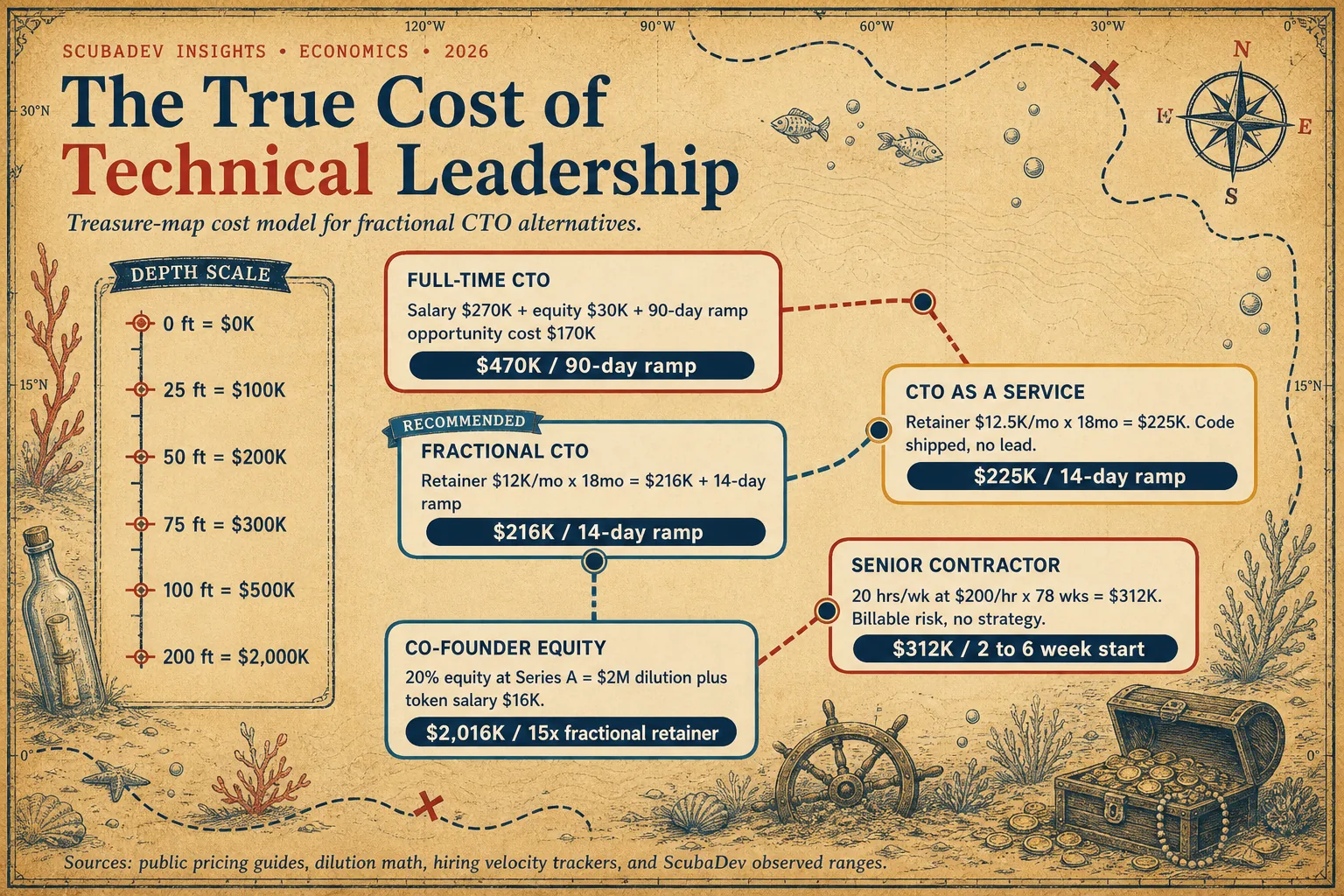
A fractional CTO costs between $8,000 and $15,000 per month in 2026. A full-time senior engineering leader can run $180K to $300K before equity and loaded costs, and the search can take 60 to 120 days. That spread is why the category exists.


By the numbers
The four data points every founder gets wrong on the fractional call
-
Full-time CTO
$180K
Base salary floor in 2026, before equity and loaded costs
-
Hiring cycle
90days
Typical senior engineering leader search window for a serious leadership hire
-
Equity premium
15x
Cost of a co-founder CTO at 20 percent versus an 18-month retainer
-
Time to start
2weeks
Standard onboarding window for a vetted fractional CTO






01 / Role matrix
What a fractional CTO actually does
Fractional is not a title. It is a pricing model for senior technical leadership.
The job covers architecture decisions, hiring loops, code review for structurally risky work, vendor selection, security posture, sprint cadence, and translation between the product roadmap and what engineering can ship.
Most retainers run 10 to 25 hours a week. The role is leadership first, not a disguised production-code engagement.
02 / What the job is
Three things a real fractional CTO owns every week
Architecture calls
Runs the room on stack decisions, reviews pull requests for anything structurally risky, and writes the one-page ADR that locks the choice in.
Hiring and 1:1s
Sits in the loop for every senior engineering hire, holds the weekly 1:1 with each senior engineer, and owns the performance conversation when it is time.
Roadmap translation
Converts the product roadmap into a sprint cadence the team can actually ship, and converts the engineering reality back into something the board can hear.
Not for
Skip the fractional conversation entirely if any of this is true
Four cases where founders pick fractional and regret it. The fastest way to save a quarter of runway is to cross the wrong category off before you start.
- 01 / In-office hours
You need someone in the office 40 hours a week.
Fractional caps at 25 hours per week per client. If you need bums-in-seats coverage or a daily standup owner, hire full time.
- 02 / Team size
Your engineering team is three people or fewer.
Fractional leverage math needs at least four reports. Below that you want a senior engineer or a productized dev team, not a leader.
- 03 / Shipping deadline
You need code shipped by Friday.
A fractional CTO leads. They do not ship MVPs on deadline. For that you want a subscription dev team and an engagement scoped around delivery.
- 04 / Equity-only
You are looking for a co-founder who will work for equity.
Fractional is a cash retainer. If you cannot fund $8K per month for six months, the conversation is about funding, not about hiring.






When the fractional model beats a full-time hire
Three scenarios push founders and operators toward fractional over full-time.
- 01
The 90-day hiring cycle
Senior engineering leadership searches routinely run 90 days or more. A fractional CTO can start in one to three weeks, which matters when runway is shorter than the hiring cycle.
- 02
The capacity gap is real but under full time
A 15-person startup may need architecture judgment, hiring support, and roadmap translation without needing an executive in every standup.
- 03
The initiative is bounded
Payments rewrites, technical due diligence, security prep, migrations, and carved-out initiatives often need senior judgment for 3 to 6 months, not a permanent executive hire.
- 04
When you actually need shipped code
If the real need is a shipped MVP or production feature by a deadline, the right category is a subscription dev team or delivery team, not fractional leadership alone.
- 05
When the team is too small
Fractional leverage needs engineers to lead. Below four reports, a senior engineer or productized dev team is usually the better fit.
- 06
When technical debt needs a rebuild
If every architecture decision is downstream of a rewrite, start with a rebuild team and a fixed sprint budget, then add leadership once the foundation is stable.
If the company needs code shipped every day, fractional leadership alone is the wrong instrument.


What the real numbers look like
Public and ScubaDev-observed ranges for 2026:
| Model | Rate | Time to start | What you get |
|---|---|---|---|
| Full-time CTO | $180K to $300K plus equity | 60 to 120 days | Everything, plus a hire you must manage |
| Fractional CTO | $8K to $15K per month, retainer | 1 to 3 weeks | Part-time leadership, no code shipped |
| Subscription dev team | $5K to $20K per month, flat | 1 to 2 weeks | Shipped code under a team lead, no management overhead |
| Senior contractor | $150 to $350 per hour | 2 to 6 weeks | Code at hourly risk, no strategic lead |
| Co-founder CTO with equity | 15 to 25 percent | Varies | Commitment, but dilution risk and split risk |
How to vet a fractional CTO in 30 minutes
Five questions separate real fractional CTOs from expensive coaches. Ask these on the first call, in this order.
- 01
Current client mix
Real fractional CTOs carry two or three retainers and can name the industries and team sizes without hesitation.
- 02
The last PR you reviewed
This is a technical screening question. A fractional CTO who cannot name a recent pull request and what they changed in it is not shipping.
- 03
Handoff if it does not work
A strong answer includes a documented transition plan, a 30-day exit clause, and a commitment to train a successor.
- 04
Stack bias
Everyone has one. A fractional CTO who claims to be stack-agnostic is either lying or has not shipped enough to form an opinion.
- 05
Show me a project context file
The 2026 fractional CTO works with AI coding agents daily. If they cannot show you their context-engineering patterns, they are running a 2022 playbook.
Fractional CTO vs CTO as a Service vs interim CTO
These terms mostly overlap but have specific connotations. All three are the same underlying job. Pick the vendor, not the label.
Fractional CTO
Implies an ongoing retainer with a fixed hour commitment. The default frame for most engagements priced in the $8K to $15K monthly range. Open-ended by design.
CTO as a Service
A phrase that trended up through 2025 and usually implies a more productized offering with a fixed scope per month. Same underlying work, packaged for clearer billing.
Interim CTO
Implies a 3 to 9 month bridge while the company runs a full-time search. Time-boxed by definition, with a planned handoff at the end of the engagement.
All three labels describe the same underlying job. Evaluate the operator, the deliverables, and the exit terms. Not the title on the proposal.
07/AT SCUBADEV
What we run at ScubaDev
We built ScubaDev for the gap between fractional CTO and full-time engineering hire. Two products, one contract, no staff-augmentation seam.
-
Subscription dev team
Flat monthly retainer for shipped code. One team lead, full velocity, no management overhead.
-
Fractional CTO retainer
Senior engineering leadership at 10 to 25 hours per week, layered on top when strategy work is live.
-
One contract, one invoice
The strategy author owns the execution. No translation layer between the roadmap and the team building it.
-
US team, 24/7 coverage
Core team in the US for synchronous strategy and code review, with a global bench for around-the-clock execution.
-
Knowledge base gap analyzer
The knowledge base gap analyzer clusters unanswered support tickets into topics your documentation does not cover, and drafts the missing articles for approval. It closes the loop on in-app AI help. The output is a practical backlog from real support demand and a trend line of repeat-question volume going down. We ship this alongside in-app AI help, and the pair cuts support load by 40 to 70 percent within 90 days in the deployments we can measure.


FAQ
How many hours per week is a typical fractional CTO retainer?
A: 10 to 25 hours per week per client. Below 10 hours you are getting an advisor. Above 25 hours at scale you are paying for full-time with none of the retention.
Is a fractional CTO the same as an advisor?
A: No. An advisor meets monthly, reads your deck, and gets equity. A fractional CTO reviews pull requests, runs your hiring loop, and gets a cash retainer.
Can a fractional CTO help me raise?
A: Yes. A fractional CTO who has shipped through multiple rounds can hold the technical story in diligence, speak to architecture decisions, and sit in the due diligence call.
Do fractional CTOs write code?
A: Sometimes, usually not. The default is leadership. If the engagement includes shipping, the retainer should spell that out explicitly.
How is a fractional CTO different from a subscription dev team?
A: Scope. A fractional CTO leads. A subscription dev team ships. If you need both, hire both.
How long are fractional CTO engagements?
A: Most run 3 to 12 months. Shorter engagements are usually migrations or bounded audits. Longer engagements usually turn into full-time hires or taper to advisory.