




Railway wins when speed, low ceremony, and low-traffic economics matter most. Render wins when the project needs predictable invoices, regional placement, and a cleaner handoff to finance or an ops owner.
The choice is rarely about whether both platforms can run the app. They can. The real decision is whether the workload is spiky and founder-led, or steady enough that fixed-instance pricing and governance matter more than the fastest first deploy.
Below the surface
The quick decision is simpler than most hosting debates make it sound. Railway is the fast lane for prototypes, internal tools, founder-led SaaS work, and anything projected under about $500 per month without international latency requirements.
Render is the calmer route for production SaaS with predictable load, finance review, multi-region requirements, mature Postgres expectations, and a team that wants infrastructure documented in config rather than remembered in a dashboard.
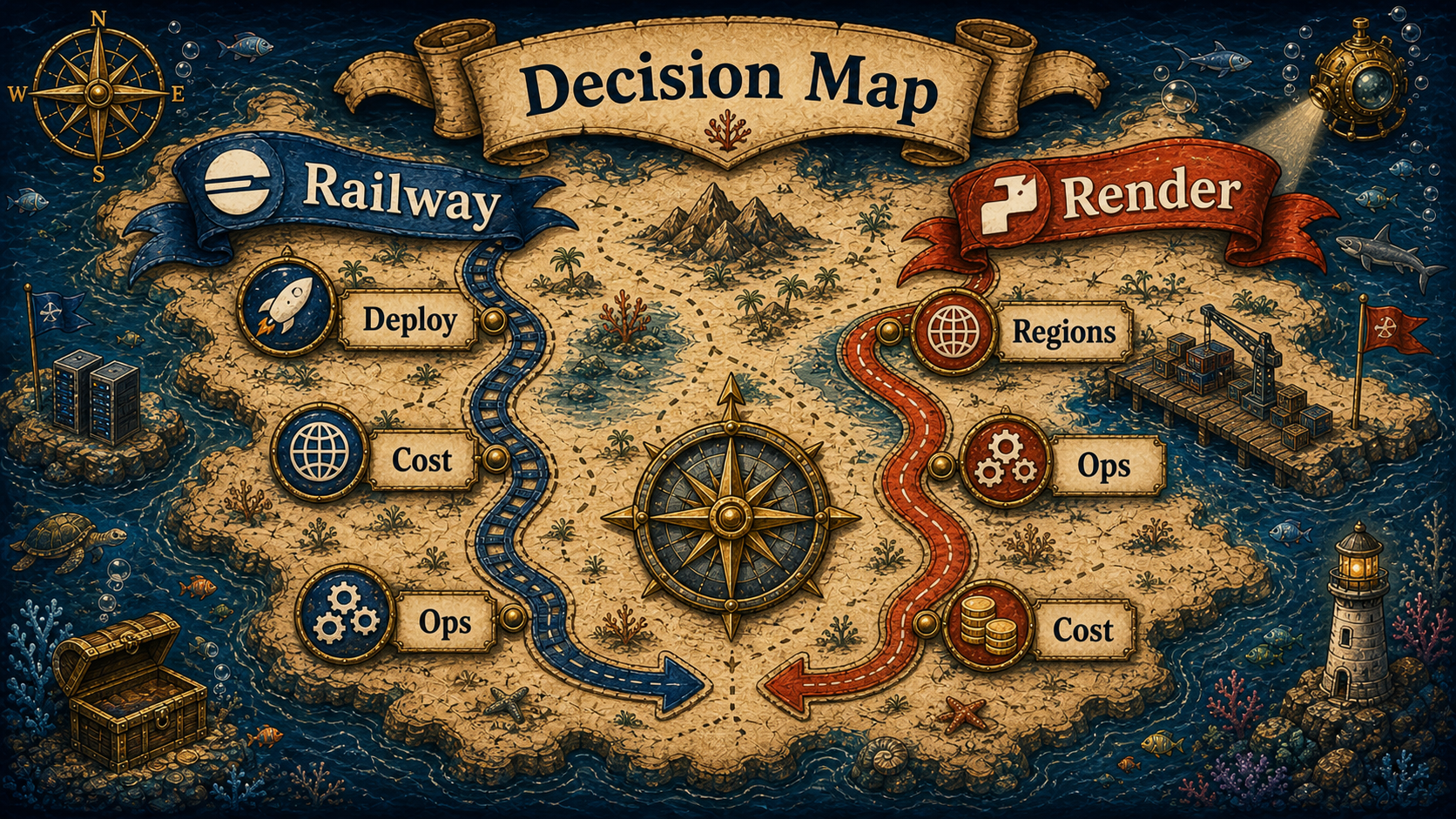


By the numbers
The hosting math that changes the call
First deploy
2-4 min
Railway usually wins the zero-to-URL race for simple Node or Python services.
Starter web
$7/mo
Render's fixed starter service is easier to approve than variable usage billing.
Regions
5
Render's regional options make it the safer choice for EU or APAC users.
Migration work
4-12 hr
Moving between the two is usually manageable if env vars and database dumps are clean.






03 / Pricing
Pricing depends on traffic shape, not toy-app math
Both platforms are cheap when nothing is happening. The difference shows up when usage gets spiky, steady, or explainable to a client finance team.
Low traffic utility
Railway lean
A dashboard used by 50 people can stay tiny on usage-based billing. Railway is usually the better fit when idle time is real.
Steady production SaaS
Render calm
Fixed instances make the monthly number legible. That matters when the buyer asks why hosting changed after a traffic spike.
Bigger workload
Ops review
Above roughly $500 per month, the call shifts from cheap hosting to predictability, latency, database maturity, and who owns operations.
The spread is often noise. For a three-service app with web, worker, and Postgres, the winner is usually decided by billing tolerance and region needs.
04 / Developer experience
Railway feels faster. Render feels more governable.
That tradeoff is the heart of the comparison. The fastest path for a two-person team is not always the cleanest path for a six-person team.
| Area | Railway | Render |
|---|---|---|
| First deploy | Fast CLI and dashboard flow, usually the cleanest zero-to-URL path. | More clicks and slower first deploy, but clearer service model. |
| Infrastructure as code | Project config works well, but the dashboard remains central. | render.yaml makes handoff and review easier for teams. |
| Preview environments | Available and useful for fast iteration. | Battle-tested for PR-based team workflows. |
| Finance review | Usage billing can trigger questions after spikes. | Fixed monthly services are easier to forecast and charge back. |
05 / Ops fit
Regions, workers, and databases decide the grown-up stack
Once the project moves past first deploy, platform shape matters more than dashboard taste.
- 01
Render wins regional placement
EU or APAC users change the answer quickly. Render's regional menu makes it the safer option when latency or data residency is part of the conversation.
- 02
Both handle workers
Background services are first-class on both. Render's worker and cron surface is calmer when there are several workers to explain and maintain.
- 03
Render has the stronger Postgres story
Small apps are fine on either. Production recovery, read replicas, and backup expectations push mature database workloads toward Render or a dedicated managed Postgres provider.
- 04
Railway keeps the small stuff moving
Internal tools, prototypes, and founder experiments do not need ceremony. When a small team needs momentum, Railway stays hard to beat.
06 / Failure modes
Where each platform breaks in real client work
Neither platform is fragile. They fail in different ways, and those failure modes map directly to buyer risk.
- 01
Railway breaks on surprise usage
The bill can move before the alert feels real. Worker loops, traffic spikes, and unclear line items are the usual problem.
- 02
Railway breaks on regional needs
Single-region assumptions show up as latency. If the user base is not mostly North America, the workaround tax becomes visible.
- 03
Render breaks when tiers are undersized
Fixed instances are predictable, not magical. A too-small service tier can still produce memory kills and deploy pain.
- 04
Render breaks on speed friction
The first path has more ceremony. For solo builders racing to validate, that extra governance can feel like drag.


FAQ
Is Railway cheaper than Render?
A: Usually below about $50 per month, yes. Above that, the answer depends on traffic shape. Steady workloads often favor Render's fixed-instance pricing. Spiky or idle-heavy workloads often favor Railway.
Which is better for a Next.js app?
A: Both work. Railway is faster for the first deploy. Render is easier to govern for teams. Vercel still wins when the app leans heavily on Next.js-specific platform features.
Can I host Postgres on both?
A: Yes. Railway is great for small app databases and prototypes. Render has the stronger production database story when backups, PITR, read replicas, and disaster recovery matter.
What about autoscaling?
A: Both have answers, but small teams usually get more value from right-sizing, alerts, and clear deployment ownership before they need aggressive autoscaling.
Can I move from one to the other?
A: Yes. Environment variables port cleanly, app services are usually straightforward, and database migration is the real work. Plan on 4 to 12 hours for a clean small-app migration.