




CTO as a service is senior engineering leadership sold as a fixed monthly subscription instead of a salary, hourly retainer, or equity-heavy cofounder search.
It fits seed to Series B teams that need architecture judgment, PR review, hiring support, roadmap translation, vendor decisions, and diligence help, but do not yet have enough executive load to justify a full-time CTO.
Below the surface
The label is new. The job is not. A subscription CTO owns the technical judgment layer: architecture calls, risky pull requests, roadmap translation, hiring loops, vendor selection, and diligence support.
The billing model is what changed. Flat monthly tiers make senior leadership purchasable before the company can afford a permanent executive, and AI-assisted engineering has compressed the weekly hours required to support multiple focused teams.


By the numbers
The leadership math behind the category
Loaded hire
310K
Approximate fully loaded annual CTO cost cited in the draft source.
Hiring cycle
60-120 days
Typical senior technical leader search window before decisions land.
Subscription band
8-20K/mo
Common monthly range for real CTO as a service scopes.
Exit clause
30 days
The practical notice standard for productized leadership engagements.






What a real service tier actually includes
The credible version has a written scope. Anything below this is usually advisory consulting with a new label.
- 01
Risky PR review
Every pull request over a size threshold, plus anything touching auth, payments, migrations, or external integrations.
- 02
Architecture decisions
Weekly architecture calls, ad hoc decision support, and translation from product roadmap into shippable backlog.
- 03
Security and diligence posture
SOC 2, HIPAA, GDPR, investor diligence, and audit support alongside the team that owns the paperwork.
- 04
Cadence and hiring loops
Sprint rhythm, senior engineer 1:1s, candidate screens, and enough executive presence to keep the team pointed.





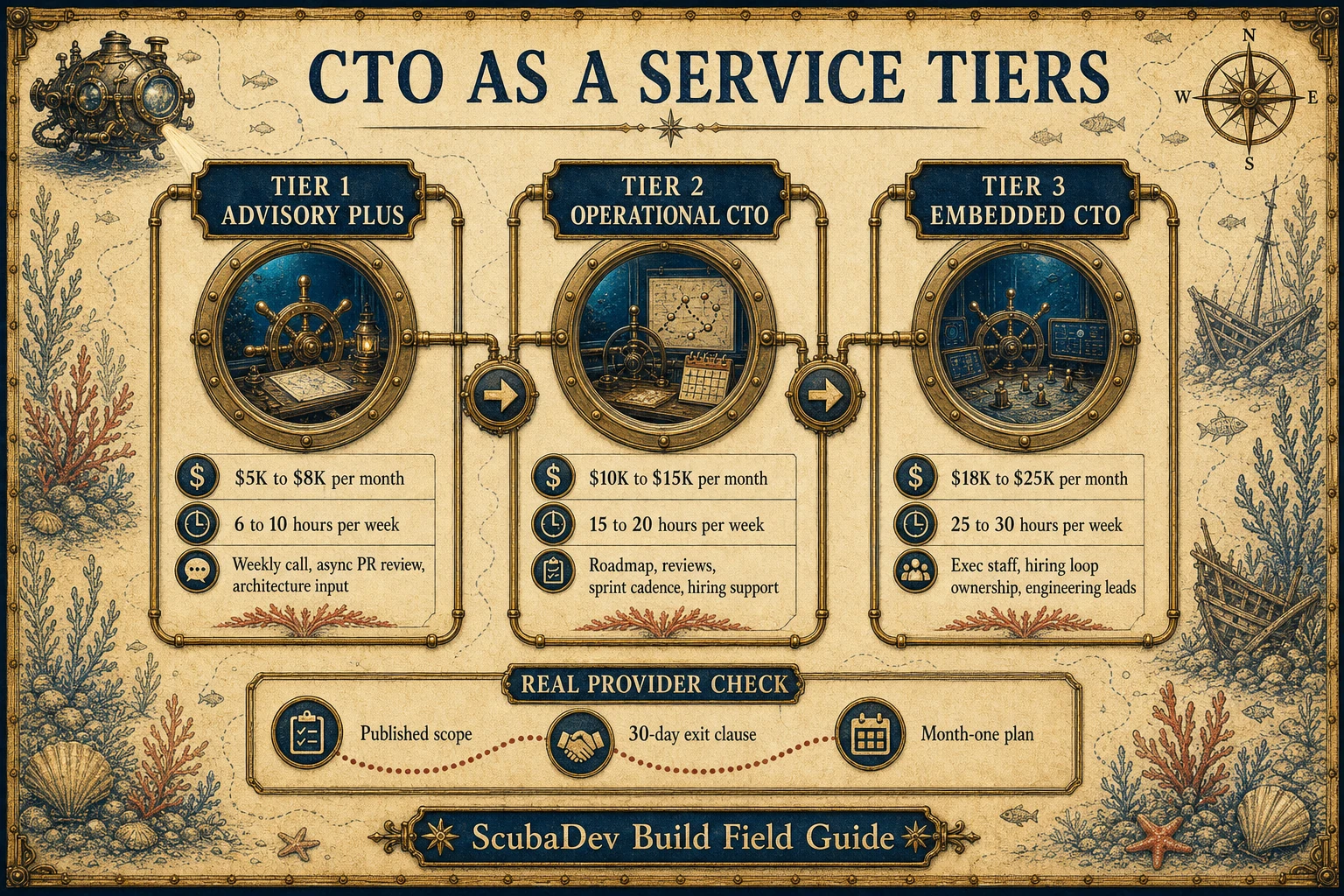
04 / Service tiers
The three-tier pattern has converged
Transparent providers usually sell advisory, operational, and embedded tiers. The useful comparison is weekly leadership time, ownership level, and monthly price.


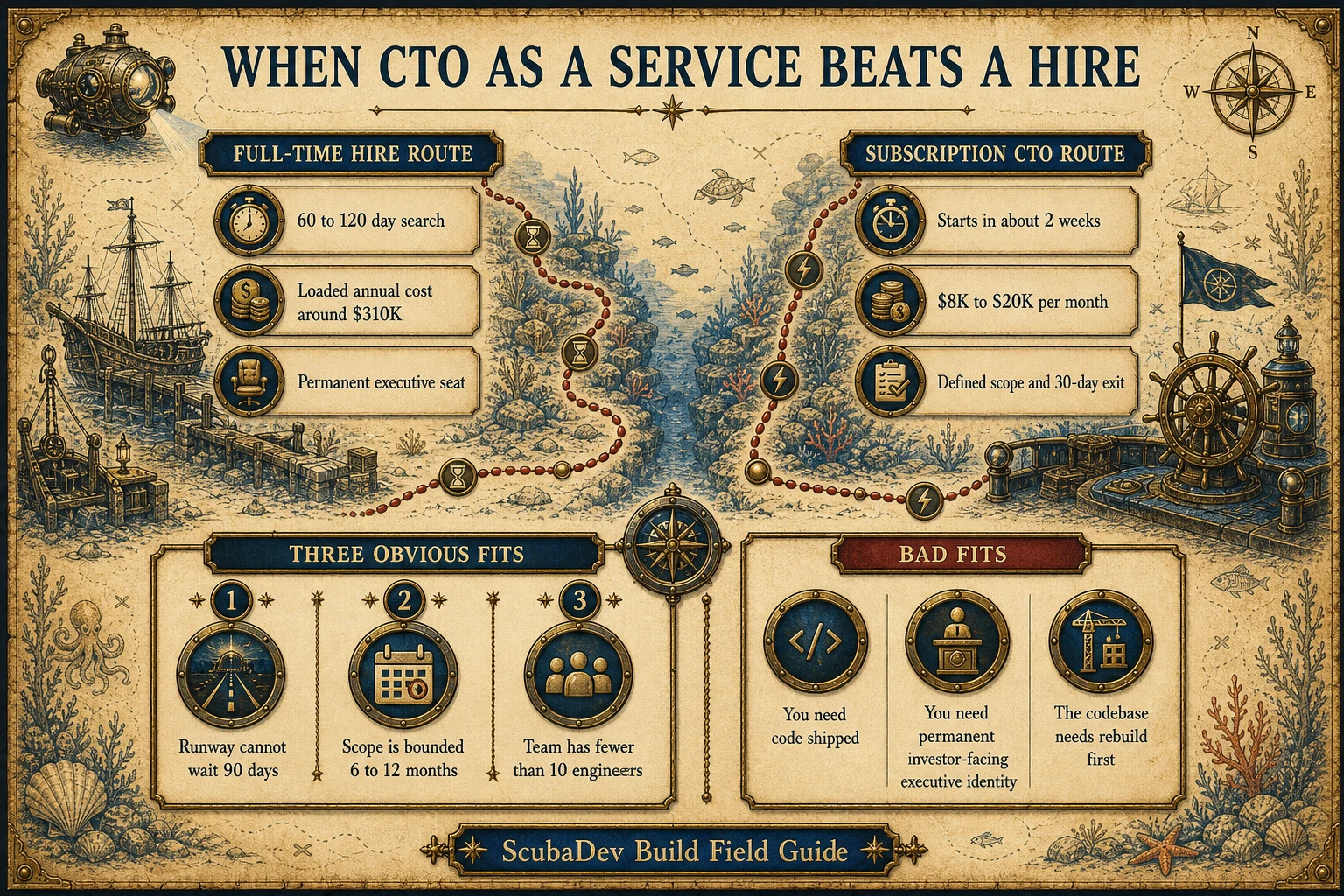
05 / Beats a hire
When the subscription model beats a full-time CTO
The math is obvious when the timeline is urgent, the scope is bounded, or the engineering team is not yet large enough to absorb a permanent executive.
Five questions that reveal whether the tier is real
A productized CTO service should be able to answer these in one sales call without custom consulting fog.
- 01
Which tier fits my stage?
A provider who cannot match a tier to your reality in ten minutes is flying blind.
- 02
What is the exit clause?
Thirty-day notice is standard. Longer is a trap. Shorter is usually marketing.
- 03
Can I see a real 30-day plan?
Names can be redacted. The shape matters: audits, PRs, hires, and architecture decisions should be named.
- 04
What is your stack bias?
Every good senior engineer has one. Stack-agnostic usually means the judgment layer is being softened for sales.
- 05
Show the AI coding setup
A 2026 CTO who does not work with coding agents daily is charging current rates for old output.


FAQ
Is CTO as a service the same as a fractional CTO?
A: Functionally yes. CTO as a service is usually the productized, tiered version. Fractional CTO is the more traditional retainer-based framing.
How long do engagements typically run?
A: Six to eighteen months is common. Shorter engagements are usually migrations, SOC 2 sprints, fundraise prep, or bounded initiatives.
Do CTO as a service providers write code?
A: Usually not. The core product is leadership. If shipped code is included, it should be scoped and priced as a separate engineering team.
Can a subscription CTO help with fundraising?
A: Yes. Technical diligence is a natural fit because a senior leader with no equity attachment can answer investor questions credibly.
How is CTO as a service different from staff augmentation?
A: Scope. Staff augmentation gives you engineers to ship under your direction. CTO as a service gives you a leader who directs the engineers.
What should a real 30-day plan look like?
A: Week one covers codebase audit and stakeholder interviews. Week two lands an architecture decision and PR rhythm. Week three starts the hiring loop. Week four prepares the first monthly business review.